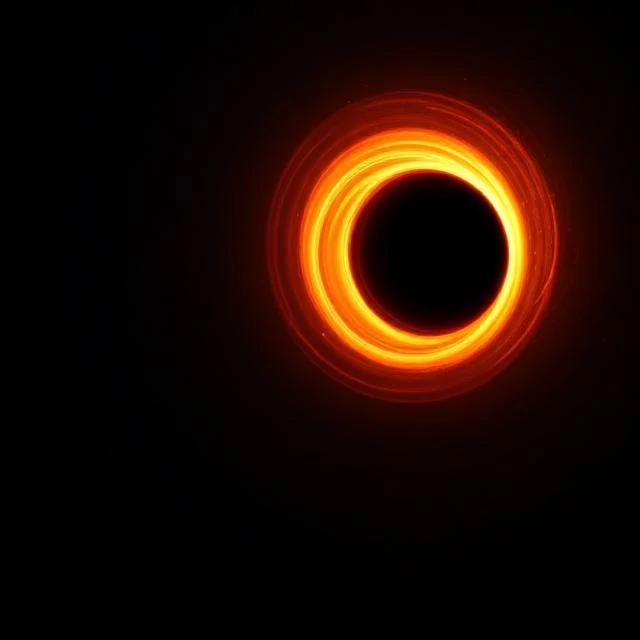
Matter rarely falls straight into a black hole. It spirals. As gas and dust draw closer to a massive object, conservation of angular momentum flattens them into a rotating disk. Friction between particles heats the disk to millions of degrees, and it glows — sometimes brighter than the entire galaxy around it.
Accretion disks form around black holes, neutron stars, white dwarfs, and young protostars. The physics differs by scale. Around a stellar-mass black hole, the disk emits X-rays. Around a protostar, it emits infrared and radio waves before planets condense out of it. The same basic mechanism operates in both cases: gravity pulls matter inward, and the disk radiates away the energy that cannot be swallowed.
Astronomers study accretion disks because they reveal the mass and spin of the central object. The inner edge of the disk around a black hole sits at the innermost stable circular orbit, a boundary set by general relativity. Measuring the X-rays from that region tests Einstein's equations in the strongest gravity available.
Comments
No comments yet. Be the first to share a thought.
Leave a comment