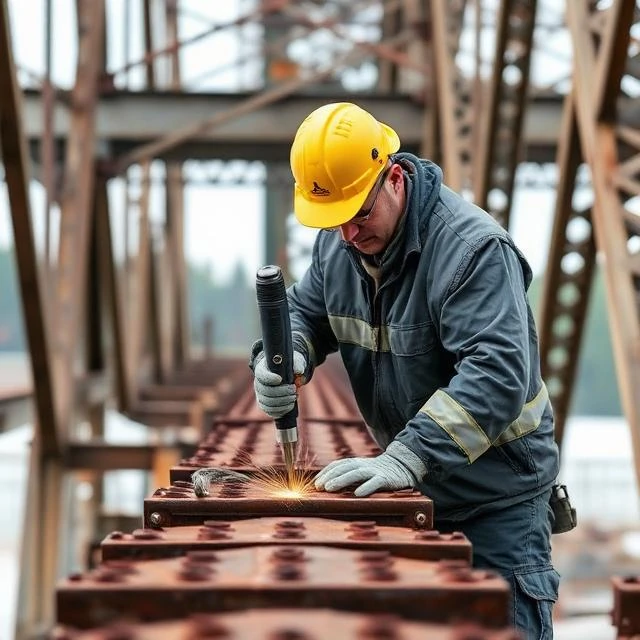
Riveting joins metal plates with permanent metal pins called rivets. A rivet is a cylindrical shaft with a head. It is inserted through holes in the plates. The tail is then deformed, or bucked, to create a second head. The rivet clamps the plates together. It cannot be removed without destroying it. Riveting was the standard method for joining steel in the 19th and 20th centuries. It built ships, bridges, and skyscrapers. In the kitchen, the closest equivalent is the crimping of a pie crust. The edges are pressed together. They are sealed. They are joined. It is not riveting. But it is a permanent join. It is the riveting of the pie. It is the riveting of the kitchen.
Riveting is a skilled trade. The riveter heats the rivet, inserts it, and bucks the tail with a pneumatic hammer. The work is loud, hot, and physical. The rivet must be the right size and the right material. The holes must be aligned and the right diameter. The rivet must fill the hole completely. In the kitchen, the crimping is a simple technique. The edges are pressed with a fork. The edges are pressed with the fingers. The edges are sealed. The pie is ready. The riveting is the join. The crimping is the join. Both are the same.
Riveting has advantages. It is strong, reliable, and permanent. It does not require electricity. It can be done in the field. It can join dissimilar metals. In the kitchen, the crimping has advantages. It is simple, quick, and effective. It does not require special tools. It can be done by hand. The riveting is the method. The crimping is the method. Both are the same. The same is the kitchen. The kitchen is the riveting. The riveting is the cook. The cook is the riveting. The riveting is the same. The same is the meal. The meal is the riveting. The riveting is the same.
Comments
No comments yet. Be the first to share a thought.
Leave a comment