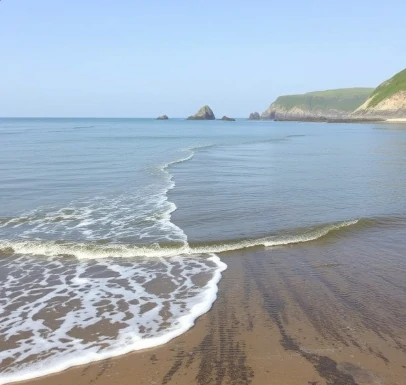
The periodic rise and fall of sea level caused by the gravitational pull of the Moon and Sun is the tide. Most coastlines experience two high and two low tides each lunar day, though some regions have diurnal or mixed patterns.
The tide-generating force arises because the gravitational attraction differs slightly across Earth’s diameter. The resulting tidal bulges move around the planet as Earth rotates, modified by continental boundaries, basin resonances, and the Coriolis effect. The relative positions of Moon and Sun produce the spring-neap cycle of larger and smaller ranges.
Tides influence navigation, coastal flooding risk, intertidal ecology, and the mixing of estuaries. They can be predicted years ahead with high accuracy because the astronomical forcing is known precisely. Local tide tables remain essential tools for mariners, fishers, and coastal residents. In a few locations the tidal range is large enough to support commercial tidal power generation.
The same gravitational physics that produces ocean tides also flexes the solid Earth by tens of centimeters.
Comments
No comments yet. Be the first to share a thought.
Leave a comment