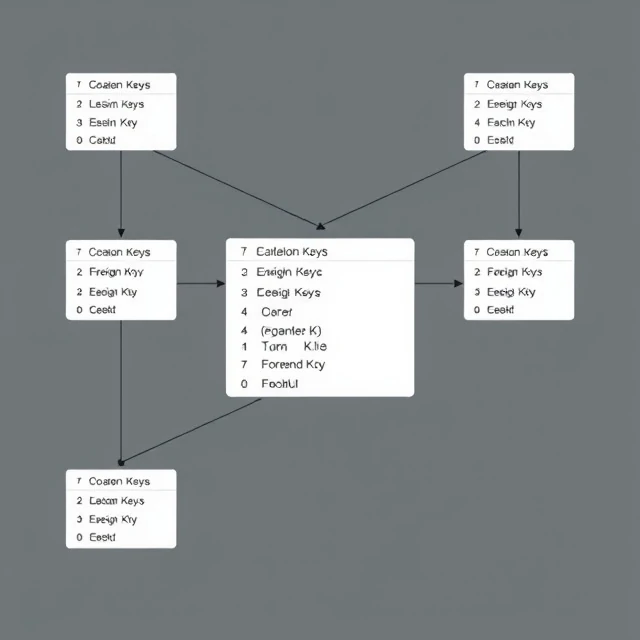
A relational database organizes data into tables with rows and columns. Each table represents an entity: customers, orders, products. Each row is a record. Each column is a field. Relationships between tables are defined by keys. A foreign key in one table points to a primary key in another. The structure is defined by a schema. The database enforces the schema, rejecting data that does not fit. That enforcement keeps the data consistent.
The relational model was proposed by Edgar Codd in 1970. It replaced earlier hierarchical and network models because it was simpler and more flexible. SQL became the standard query language. Decades later, relational databases still run most of the world's transactional systems. They are reliable, well-understood, and ACID-compliant. Atomicity, consistency, isolation, and durability guarantee that transactions either complete fully or not at all. That guarantee matters for banking, inventory, and any system where partial updates cause problems. Relational databases scale vertically by adding more power to a single server. They scale horizontally with sharding, but that adds complexity. NoSQL databases handle horizontal scaling more naturally, which is why they gained popularity for web-scale applications. Relational databases remain the default for applications that need strong consistency and complex queries. The technology is mature. The trade-offs are well understood.
Relational database characteristics
- Tables — data organized by entity
- Rows and columns — records and fields
- Keys — primary and foreign keys define relationships
- SQL — standard query language
- ACID — transactional guarantees
A relational database is a set of tables with rules. The rules keep the data consistent. The tables keep it organized.
Comments
No comments yet. Be the first to share a thought.
Leave a comment