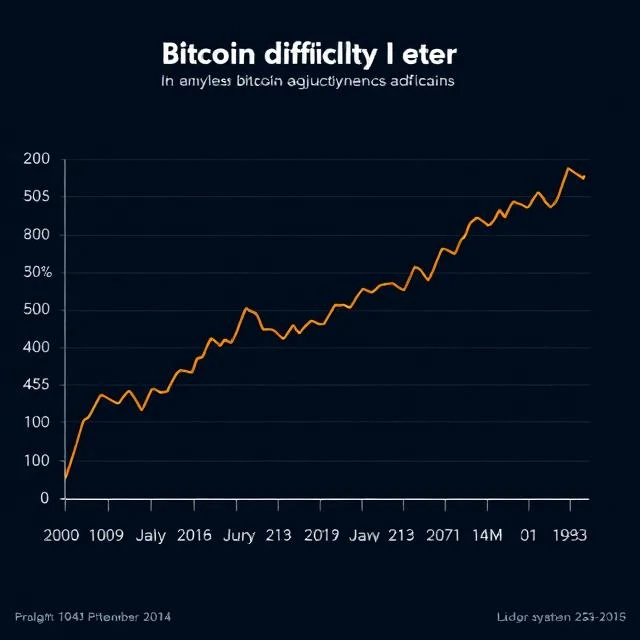
Difficulty measures how hard it is to find a new block. In proof-of-work mining, miners compete to find a hash below a target value. The lower the target, the harder the puzzle. Difficulty adjusts automatically based on how fast blocks are being found. Bitcoin targets one block every ten minutes. If miners find blocks faster than that, difficulty rises. If blocks slow down, difficulty falls. The network recalibrates every 2016 blocks, roughly two weeks.
The adjustment keeps block production steady regardless of how much mining power joins or leaves. When China banned mining in 2021, Bitcoin's hash rate dropped sharply. Difficulty fell in response. Miners elsewhere filled the gap. The chain kept producing blocks at roughly the same pace. Difficulty is not set by a committee. It is a feedback loop written into the protocol. More hash rate means higher difficulty, which means miners need more power to earn the same reward. The competition drives efficiency and consolidation.
Difficulty mechanics
- Targets a fixed block time — 10 minutes for Bitcoin
- Adjusts every 2016 blocks — approximately two weeks
- Rises with more mining power, falls with less
- Protects against fast blocks that would inflate supply
Difficulty is one reason Bitcoin mining keeps getting more industrialized. Small miners with cheap hardware cannot compete when difficulty is high.
Comments
No comments yet. Be the first to share a thought.
Leave a comment