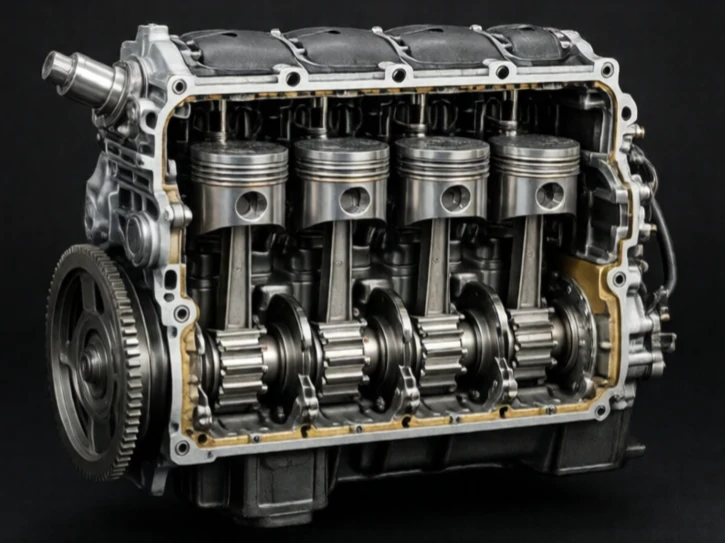
Burn fuel inside a sealed cylinder, let the expanding gas push a piston, and you have an internal combustion engine. The idea is simple. Making it reliable took more than a century of tinkering.
Nicolaus Otto built the first practical four-stroke engine in 1876. Rudolf Diesel followed with compression ignition in the 1890s. The four-stroke cycle, intake, compression, power, exhaust, still governs most engines on the road. A two-stroke version fires every revolution and lives on in chainsaws and some motorcycles.
Core components
- Cylinder block and pistons.
- Crankshaft to convert linear motion to rotation.
- Valves and camshaft to control gas flow.
- Fuel system to mix air and fuel.
- Cooling and lubrication systems.
Efficiency is the weak point. Most gasoline engines convert only about a quarter of the fuel's energy into motion. The rest leaves as heat through the exhaust and radiator. Turbocharging, direct injection, and variable valve timing have narrowed the gap, but electric motors still convert energy far more efficiently. That is why the internal combustion engine faces its first serious rival in a hundred years.
Comments
No comments yet. Be the first to share a thought.
Leave a comment