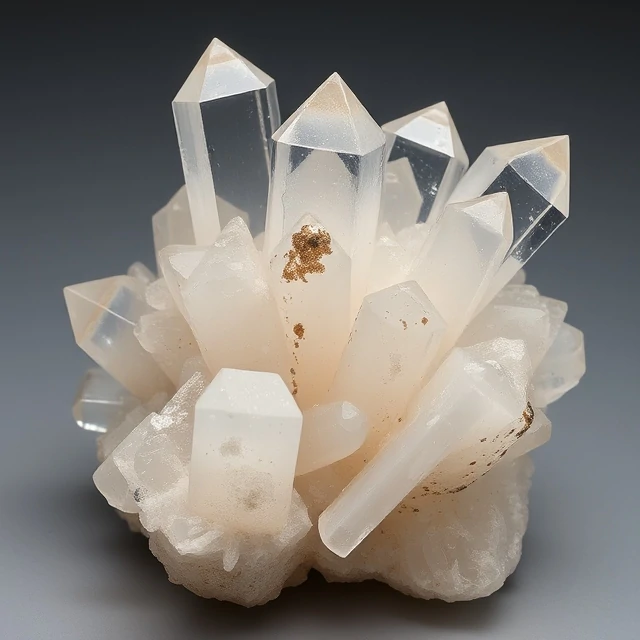
Atoms that settle into a repeating three-dimensional pattern produce a crystal. The ordered internal structure gives crystals their flat faces, characteristic angles, and distinctive physical properties. Most minerals form as crystals when melts cool or solutions become supersaturated.
Crystal systems classify the symmetry of the lattice—cubic, hexagonal, tetragonal, and others. Habit describes the external shape that develops under particular growth conditions. Impurities and growth rate influence color and clarity.
Large, well-formed crystals are prized by collectors and useful in industry for their optical, electrical, or mechanical qualities. Geologists examine crystal shape and intergrowths to interpret the temperature, pressure, and chemistry of the environment in which the mineral grew. The internal order is what ultimately distinguishes a true crystal from amorphous glass.
- Solid with ordered atomic arrangement
- Exhibits characteristic faces and angles
- Classified by crystal system and habit
- Forms from melts or solutions
Comments
No comments yet. Be the first to share a thought.
Leave a comment