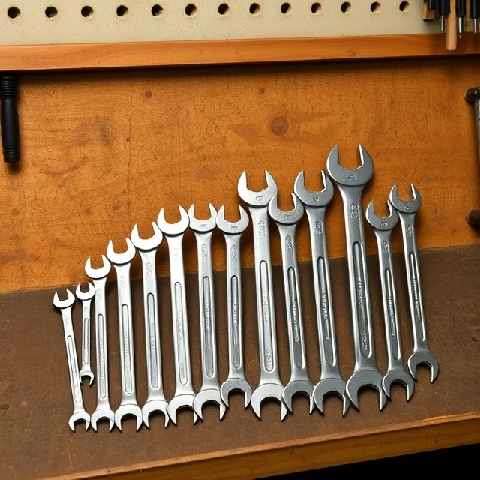
Somebody has to loosen a bolt that has been rusted in place for twenty years. The wrench is the tool that does it. It grips the head of a nut or bolt and turns it, converting the force of a hand into torque. The jaws must fit snugly. A loose fit rounds the corners, and a rounded nut is a much harder problem. In the kitchen, the closest equivalent is a jar opener, which grips a lid and turns it. The principle is the same: grip, then turn.
Wrenches come in many forms. An open-end wrench has a U-shaped jaw and grips two sides of a fastener. A box-end wrench has a closed ring with twelve points, so it can work in tight spaces. A combination wrench has one of each. A socket wrench uses interchangeable sockets on a ratcheting handle, which is faster than repositioning a fixed wrench. An adjustable wrench fits many sizes but slips more easily. A pipe wrench has serrated, self-tightening jaws for round pipe.
Size matters more than brand. Metric and imperial wrenches are not interchangeable. A 13mm wrench on a 1/2-inch nut will round it. For stubborn fasteners, a longer handle adds leverage, but too much force can snap the bolt or the wrench. The wrench is a lever. It multiplies force. That is its power and its danger.
Comments
No comments yet. Be the first to share a thought.
Leave a comment