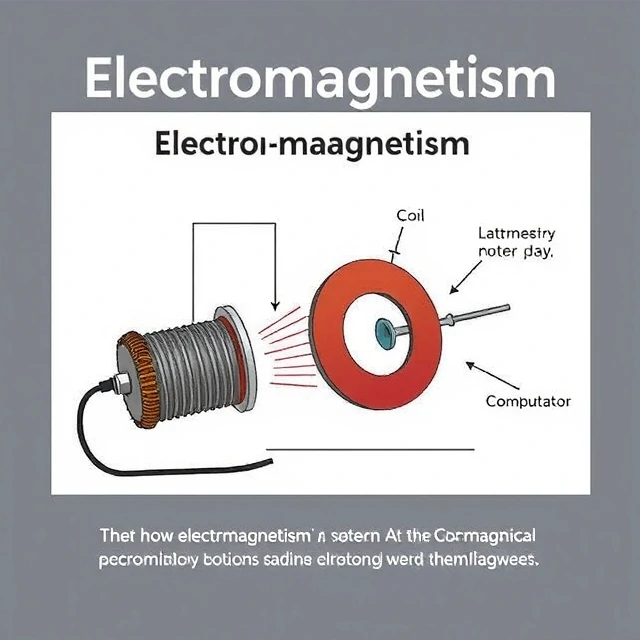
Electricity and magnetism are two sides of the same coin. A moving electric charge produces a magnetic field. A changing magnetic field produces an electric field. Together they form electromagnetism, one of the four fundamental forces of nature. James Clerk Maxwell unified the two in the 1860s with a set of equations that describe how electric and magnetic fields interact. His equations predicted that light is an electromagnetic wave, a prediction that was confirmed and that led to radio, television, and radar.
Electromagnetism governs the behavior of atoms, molecules, and all of chemistry. It holds electrons in orbit around nuclei. It binds atoms into molecules. It drives chemical reactions. It is responsible for friction, elasticity, and the hardness of solids. In everyday life, electromagnetism is everywhere. Electric motors, generators, transformers, and relays all rely on it. So do magnets, compasses, and the magnetic strips on credit cards. The electromagnetic force is carried by photons, the particles of light. It has infinite range, though its strength falls off with distance.
Electromagnetism facts
- Unification. Maxwell's equations, 1860s.
- Force carrier. Photon.
- Range. Infinite, falls off with distance.
- Applications. Motors, generators, transformers, magnets.
- Chemistry. Governs atomic and molecular interactions.
Electromagnetism is not the same as gravity. Gravity is weaker and always attractive. Electromagnetism can attract or repel.
Comments
No comments yet. Be the first to share a thought.
Leave a comment