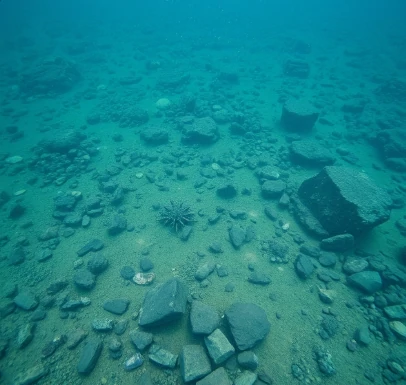
The bottom of the ocean—the seafloor—covers more than 70 percent of Earth’s solid surface. It comprises continental shelves and slopes, abyssal plains, mid-ocean ridges, seamounts, trenches, and a variety of sedimentary and volcanic features.
The seafloor is the interface where the ocean interacts with the solid Earth. Sediments accumulate, crust is formed and destroyed, and hydrothermal fluids exchange heat and chemicals. Biological communities range from sparse abyssal fauna to dense vent assemblages and deep-water coral gardens. Light is absent below a few hundred meters, so most seafloor ecosystems rely on organic matter sinking from above or on chemical energy.
Mapping the seafloor has accelerated with multibeam sonar and autonomous vehicles, yet large areas remain poorly charted. Interest in seafloor resources—minerals, hydrocarbons, genetic material—is growing, raising questions of environmental management and international governance. The seafloor is both a scientific frontier and an emerging arena of human activity.
- Bottom surface of the ocean
- Includes plains, ridges, trenches, and seamounts
- Host to diverse geological and biological processes
- Still incompletely mapped
Comments (3)
Leave a comment