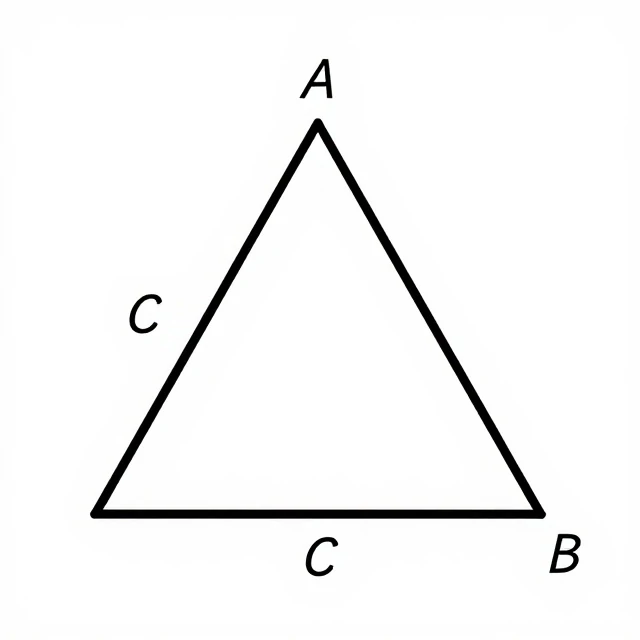
A scalene triangle has three sides of different lengths. All three angles are also different. No symmetry. No equal sides. It is the most general triangle. Every triangle that is not isosceles or equilateral is scalene.
The word comes from the Greek skalenos, meaning uneven. The angles opposite the longer sides are larger. The largest angle is opposite the longest side. The smallest angle is opposite the shortest side. The sum of the angles is always 180 degrees. That is true for all triangles.
Scalene triangle properties
- All sides different lengths.
- All angles different measures.
- No lines of symmetry.
- Can be acute, obtuse, or right.
- Area can be found using Heron's formula.
Scalene triangles are the default. Most triangles you encounter are scalene. A triangle formed by three random points is almost certainly scalene. Isosceles and equilateral triangles are special cases. They have symmetry, which makes them useful in design and engineering. Scalene triangles are general. They appear in trusses, bridges, and roof frames. The uneven sides distribute forces in complex ways. Heron's formula gives the area from the side lengths alone. No need for height. That is useful when the height is hard to measure. The scalene triangle is a reminder that not everything is symmetric. Most things are not. The general case is often messier than the special case. But it is also more common. The scalene triangle is the general triangle. It is the rule, not the exception.
Comments
No comments yet. Be the first to share a thought.
Leave a comment