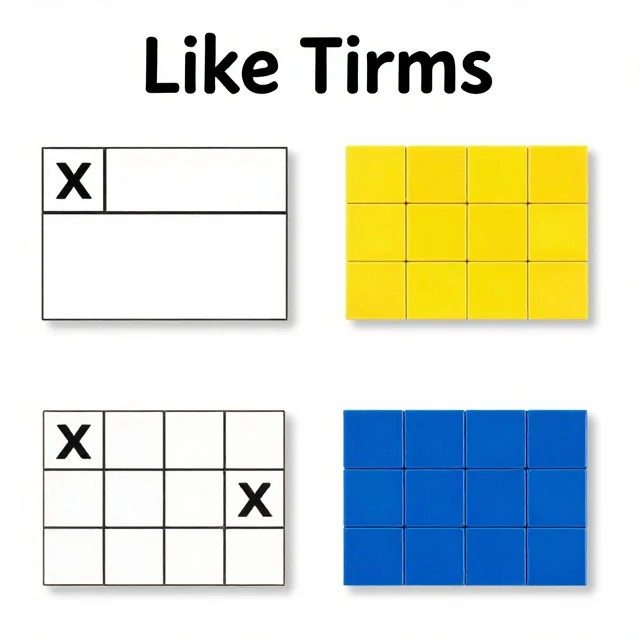
Like terms have the same variables raised to the same powers. They can be combined by adding or subtracting their coefficients. 3x and 5x are like terms. 2y^2 and 7y^2 are like terms. 4x and 4x^2 are not. The variables have different powers. They cannot be combined.
Combining like terms simplifies expressions. 3x + 5x = 8x. 2y^2 - 7y^2 = -5y^2. The variable part stays the same. Only the coefficient changes. Think of it as counting. Three x's plus five x's equals eight x's. The x is the unit. The coefficient is the count.
Identifying like terms
- Same variable or variables.
- Same exponent on each variable.
- Coefficients can be different.
- Order of variables does not matter: xy and yx are like terms.
- Constants are like terms with each other.
Like terms are the basis of algebraic simplification. Before you can solve an equation, you combine like terms on each side. 2x + 3 + 4x - 1 becomes 6x + 2. Then you can isolate x. Without combining like terms, the equation is cluttered and hard to solve. The distributive property often creates like terms. 3(x + 2) becomes 3x + 6. The 3x and the 6 are not like terms. They cannot be combined. But if there is another x term, it can be combined with 3x. The key is to check the variable and the exponent. If they match, combine. If they do not, leave them alone. It is a simple rule, but it prevents a lot of errors.
Comments
No comments yet. Be the first to share a thought.
Leave a comment