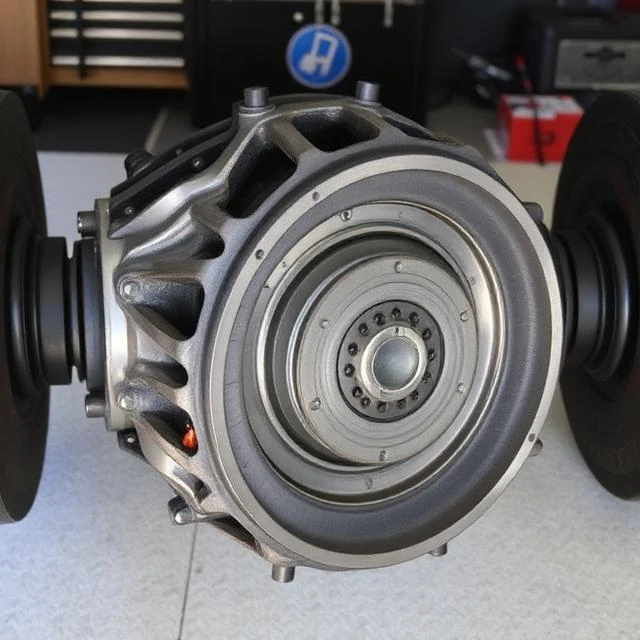
When a car turns, the outside wheels travel farther than the inside wheels. If both were locked to the same axle, one would have to slip. The differential solves that problem. It is a gear system that allows the drive wheels to rotate at different speeds while still transmitting power from the engine.
The simplest differential uses a set of bevel gears. The ring gear turns the carrier, which holds the pinion gears. Those pinions mesh with side gears connected to the axle shafts. When both wheels turn at the same speed, the pinions do not rotate. When one wheel slows, the pinions spin, allowing the other wheel to speed up. The average speed of the two wheels stays the same.
Open differentials work well on dry pavement but have a weakness. If one wheel loses traction, it spins, and the other wheel gets no torque. That is why off-road vehicles and performance cars use limited-slip differentials, which transfer torque to the wheel with grip. Locking differentials go further, locking both wheels together for maximum traction.
All-wheel-drive and four-wheel-drive systems use differentials at the front, rear, and sometimes the center. The center differential manages the speed difference between the front and rear axles. Electronic systems can now brake a spinning wheel and send torque to the others, reducing the need for mechanical limited-slip devices.
Comments
No comments yet. Be the first to share a thought.
Leave a comment