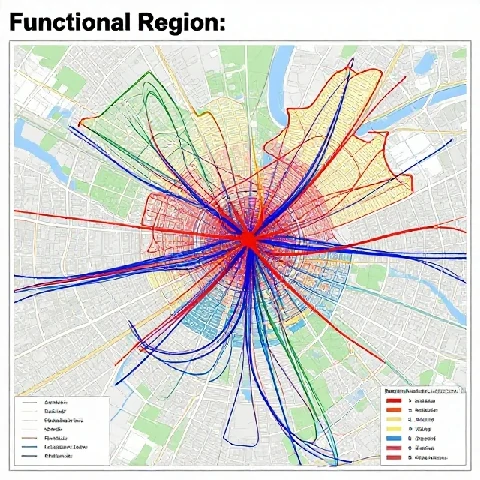
A functional region is an area organized around a central node. The node is the focal point. It might be a city, a port, or a factory. The region is defined by the flow of people, goods, or information. The boundaries are where the influence fades. A functional region is also called a nodal region.
The commuting zone of a city is a functional region. Workers travel from suburbs to the central business district. The boundary is where commuting stops. The delivery area of a newspaper is a functional region. The newspaper serves a central city and surrounding towns. The boundary is where delivery ends. The region is defined by the interaction, not by a shared trait.
Functional region examples
- Metropolitan area: city and suburbs linked by commuting.
- Delivery zone: newspaper or pizza delivery area.
- Trade area: region served by a port.
- Broadcast area: radio or TV signal range.
- Watershed: area drained by a river system.
Functional regions are dynamic. The boundaries change as the flow changes. A new highway extends the commuting zone. A new port shifts the trade area. The region is defined by function, not by form. That makes it flexible. It also makes it harder to map. The boundaries are not sharp. They are gradients. The influence of the node decreases with distance. At some point, it becomes negligible. That is the boundary. Functional regions are useful for planning. They show how places are connected. They show where investment is needed. They show the reach of a city or a service. A functional region is a system. It is a web of interactions. The node is the center. The region is the reach.
Comments
No comments yet. Be the first to share a thought.
Leave a comment