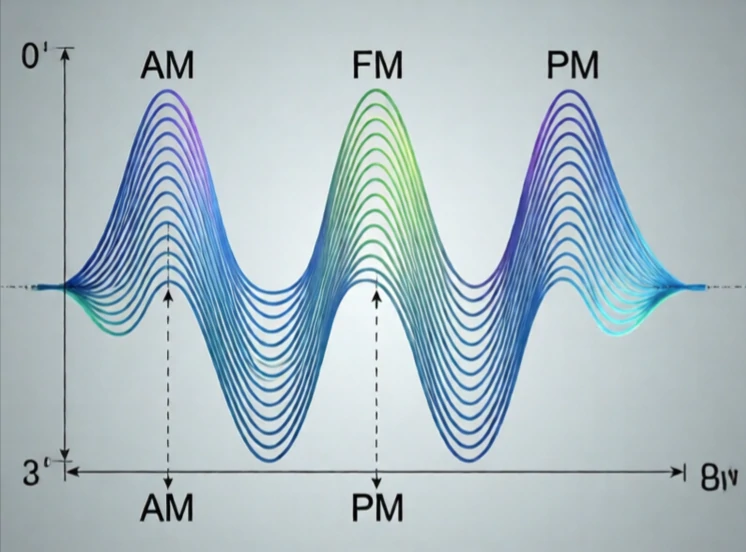
Modulation is the process of encoding information onto a carrier wave. The carrier is a steady high-frequency signal. The information changes the carrier's amplitude, frequency, or phase. The result is a signal that carries data and can travel long distances. Modulation is how information gets from here to there.
There are many modulation schemes. AM varies amplitude. FM varies frequency. PM varies phase. QAM varies both amplitude and phase, encoding multiple bits per symbol. OFDM uses many subcarriers, each modulated. The choice depends on the channel, the data rate, and the noise.
Common modulation types
- AM: amplitude modulation
- FM: frequency modulation
- PM: phase modulation
- QAM: quadrature amplitude modulation
- OFDM: orthogonal frequency division multiplexing
- FSK: frequency shift keying
Modulation is a trade-off. Higher-order modulation carries more data but is more susceptible to noise. Lower-order modulation is robust but slower. Adaptive modulation changes the scheme based on conditions. When the signal is clean, it uses a fast scheme. When it is noisy, it falls back to a slow one. The network adapts.
Comments (2)
Leave a comment