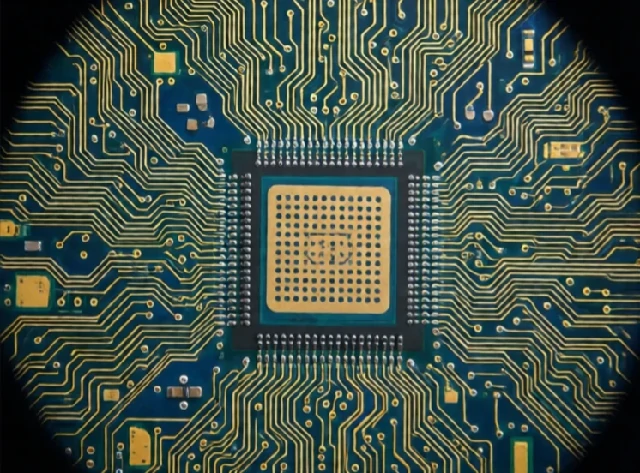
In 1958, Jack Kilby at Texas Instruments built the first integrated circuit. It was a sliver of germanium with a few components. Today, an integrated circuit can hold billions of transistors on a chip the size of a fingernail. The IC is the foundation of modern electronics.
An integrated circuit is a chip containing many electronic components — transistors, resistors, capacitors — fabricated on a single semiconductor wafer. Instead of wiring separate parts, engineers print them all at once. This made electronics smaller, cheaper, and more reliable.
Types of ICs
- Analog: amplifiers, sensors, power management
- Digital: logic gates, processors, memory
- Mixed-signal: both analog and digital on one chip
- ASIC: custom-designed for a specific task
- FPGA: programmable after manufacturing
Moore's Law described the doubling of transistors on a chip every two years. It held from the 1960s until recently. Now physical limits are slowing the pace. Chipmakers stack layers and use new materials to keep improving. The IC is still the engine of the digital age.
Comments
No comments yet. Be the first to share a thought.
Leave a comment