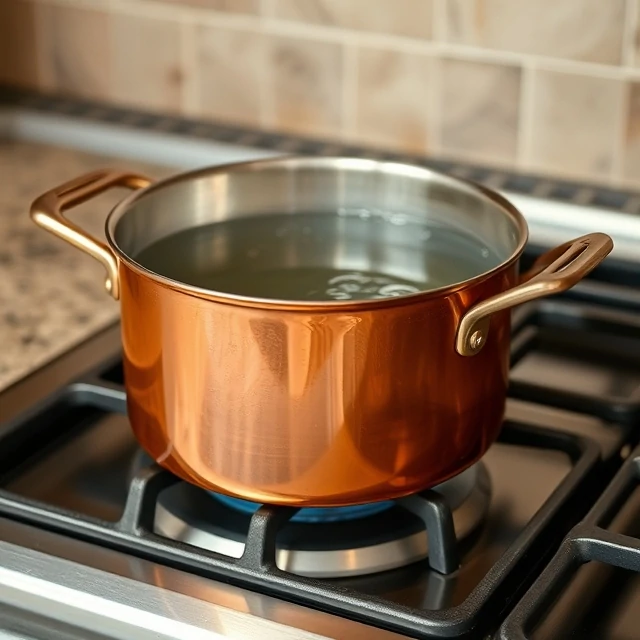
Different substances heat up at different rates. Water takes a long time to boil. Metal heats up quickly. That difference is captured by specific heat, the amount of heat required to raise the temperature of one unit mass of a substance by one degree. Water has a high specific heat, about 4.18 joules per gram per degree Celsius. Copper has a low specific heat, about 0.39 joules per gram per degree Celsius. That is why a copper pot heats up faster than the water inside it.
Specific heat is important in many fields. In climate science, the high specific heat of water moderates coastal temperatures. The ocean absorbs and releases heat slowly, keeping coastal climates milder than inland ones. In engineering, specific heat is used to design cooling systems and heat exchangers. In cooking, it explains why a metal pan gets hot quickly while the food inside cooks slowly. Specific heat is related to heat capacity, which is the amount of heat needed to raise the temperature of an entire object by one degree. Heat capacity depends on mass. Specific heat does not. It is an intensive property, meaning it does not depend on the amount of substance.
Specific heat facts
- Definition. Heat to raise unit mass by one degree.
- Units. J/g°C or J/kg·K.
- Water. 4.18 J/g°C, high.
- Copper. 0.39 J/g°C, low.
- Applications. Climate, engineering, cooking.
Specific heat is not the same as heat capacity. Specific heat is per unit mass. Heat capacity is for an entire object.
Comments
No comments yet. Be the first to share a thought.
Leave a comment