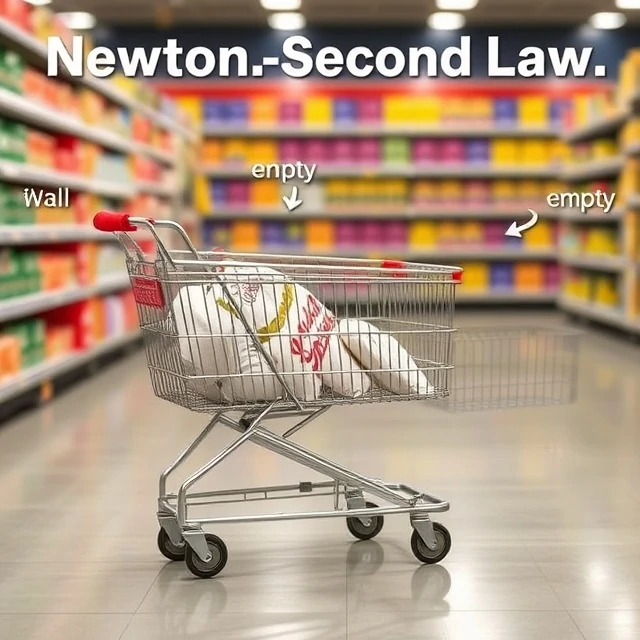
Push a shopping cart and it accelerates. Push it harder and it accelerates more. Fill it with groceries and it accelerates less. That relationship is Newton's second law: force equals mass times acceleration, or F = ma. It is one of the most useful equations in physics. It tells you how much force is needed to accelerate an object of a given mass, or how much an object will accelerate when a given force is applied. It applies to everything from a falling apple to a rocket launching into space.
The second law is a vector equation. Force and acceleration are both vectors, meaning they have direction. The acceleration is in the same direction as the net force. If multiple forces act on an object, you add them as vectors to find the net force. The second law also works in a more general form: force equals the rate of change of momentum. That form is needed when mass changes, as in a rocket burning fuel. The second law is not a definition of force. It is a relationship between force, mass, and acceleration. It tells you that if you know two of the three, you can calculate the third.
Key points
- Equation. F = ma.
- Vector. Force and acceleration have direction.
- Net force. Sum of all forces on an object.
- General form. F = dp/dt.
- Applications. From falling apples to rocket launches.
Newton's second law is not the same as the first law. The first law defines force. The second law quantifies it.
Comments
No comments yet. Be the first to share a thought.
Leave a comment