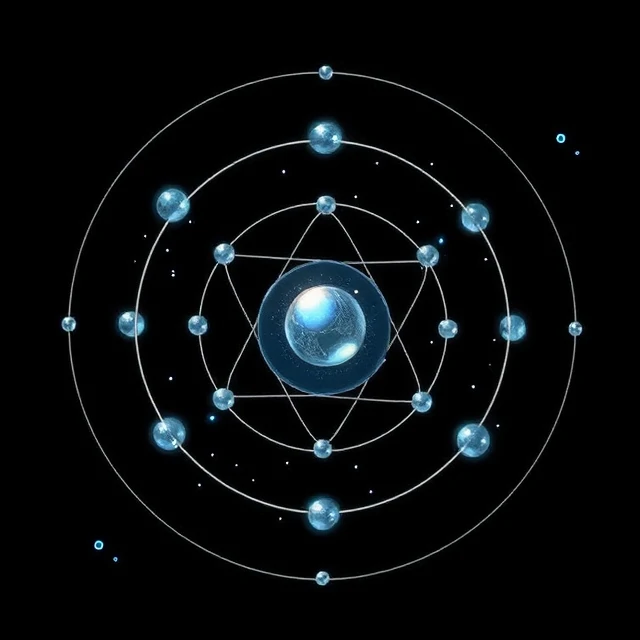
The electron is one of the three main particles that make up an atom. It carries a negative charge, about 1.6 × 10⁻¹⁹ coulombs, and a mass about 1/1836 that of a proton. Electrons orbit the nucleus in clouds of probability, not in neat circles. Their arrangement determines the chemistry of an element. Atoms share, gain, or lose electrons to form bonds, and those bonds make molecules, crystals, and everything else.
Electrons are fundamental particles. They have no known internal structure. They belong to a class called leptons. Each electron has a corresponding antiparticle, the positron, which has the same mass but positive charge. When an electron meets a positron, they annihilate and produce photons. Electrons are also responsible for electricity. In a metal, some electrons are free to move through the lattice, carrying current. In a semiconductor, electrons and holes carry current. In a superconductor, electrons pair up and flow without resistance. The electron was discovered by J.J. Thomson in 1897, through experiments with cathode rays.
Electron facts
- Charge. Negative, -1.6 × 10⁻¹⁹ C.
- Mass. About 9.11 × 10⁻³¹ kg.
- Discovery. J.J. Thomson, 1897.
- Antiparticle. Positron.
- Role. Determines chemistry and carries electric current.
Electrons are not the same as protons. Protons are heavier, positively charged, and sit in the nucleus. Electrons are lighter and orbit outside.
Comments
No comments yet. Be the first to share a thought.
Leave a comment