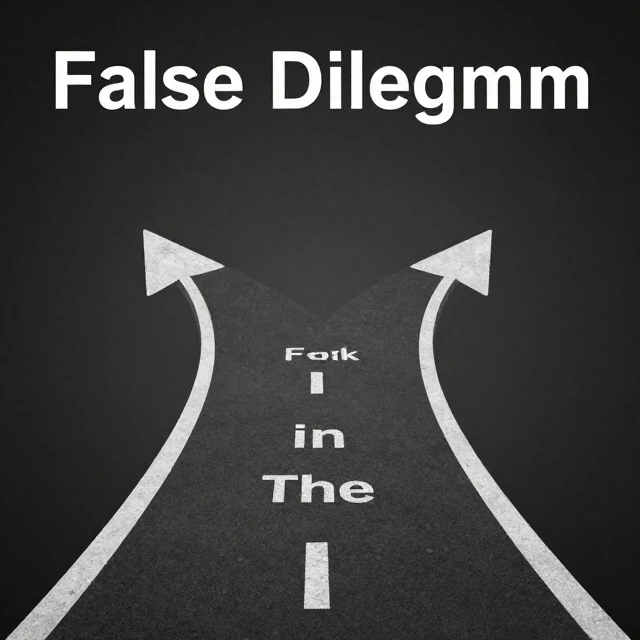
A false dilemma presents only two options when more exist. You are either with us or against us. You can either support this policy or you hate the country. The dilemma is false because there are other positions. You can be with us on some issues and against us on others. You can oppose the policy without hating the country.
The fallacy is also called the either/or fallacy. It oversimplifies complex issues. It forces a choice between two extremes. It ignores the middle ground. It ignores nuance. It is common in politics, advertising, and arguments with children. You can either eat your vegetables or go to bed. Those are not the only options.
False dilemma examples
- You are either part of the solution or part of the problem.
- America: love it or leave it.
- You can either buy this car or be stuck with a clunker.
- If you do not support this war, you support the terrorists.
- You are either a genius or an idiot.
False dilemmas are persuasive because they simplify. They make the choice easy. They pressure the audience. But they are fallacies. The world is complex. Most issues have multiple positions. Most people hold mixed views. The false dilemma ignores that. It presents a binary. The remedy is to ask: are there other options? Usually there are. The false dilemma is a rhetorical device. It can be used for good or ill. A leader might use it to rally support. A parent might use it to get compliance. But in reasoning, it is a fallacy. It distorts the issue. It shuts down discussion. It is a false choice.
Comments
No comments yet. Be the first to share a thought.
Leave a comment