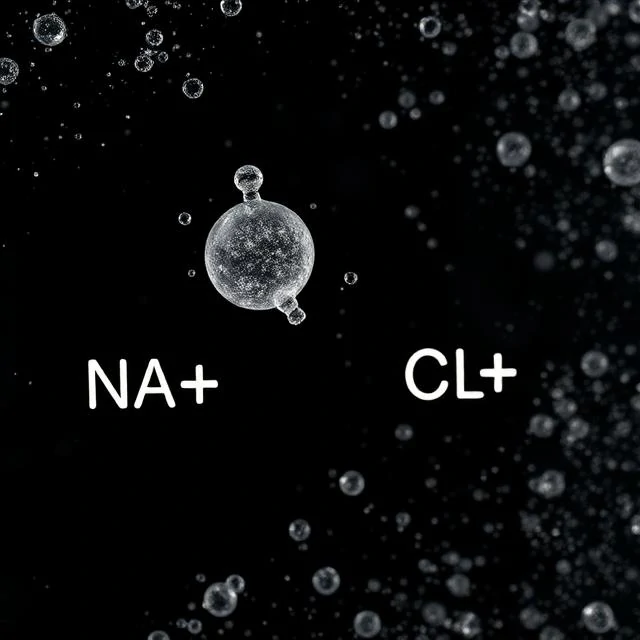
Sodium explodes in water. Chlorine is a poison gas. Combine them, and you get table salt, a stable crystal you sprinkle on fries. The difference is an ionic bond, the electrostatic attraction between oppositely charged ions. Sodium donates an electron to chlorine. Sodium becomes a positive cation. Chlorine becomes a negative anion. Opposites attract, and the lattice holds together.
Ionic bonds form between metals and nonmetals, usually when the electronegativity difference is large. The metal loses electrons easily. The nonmetal gains them eagerly. The resulting ions arrange themselves in a repeating three-dimensional lattice, not in discrete pairs. Each cation is surrounded by anions, and each anion by cations. The lattice energy, the energy released when the ions come together, determines how strong the bond is.
Properties follow from the structure. Ionic compounds have high melting and boiling points because the lattice is strong. They are hard and brittle because shifting the layers brings like charges together, causing repulsion and fracture. They dissolve in water, where the polar solvent pulls the ions apart. And they conduct electricity when molten or dissolved, because the ions are free to move.
Comments
No comments yet. Be the first to share a thought.
Leave a comment