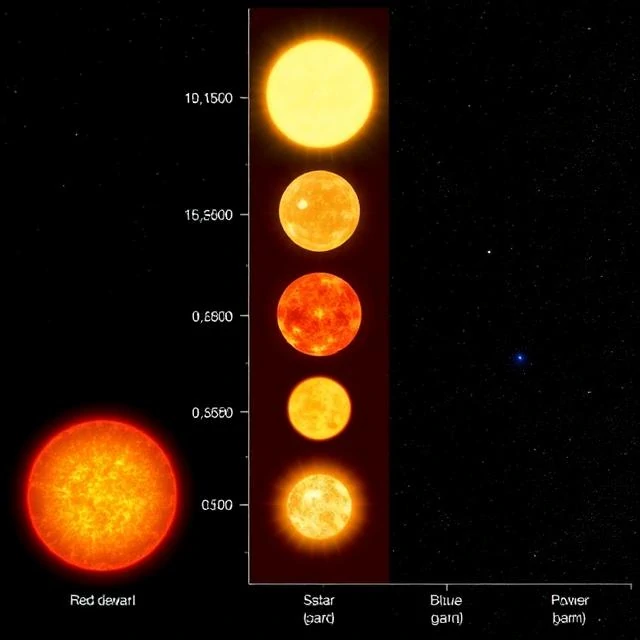
Luminosity is the total amount of energy a star radiates per unit time. It is an intrinsic property, independent of distance. The Sun's luminosity is about 3.8 times 10 to the 26th power watts. That is the standard unit astronomers use, called the solar luminosity.
Luminosity depends on a star's size and temperature. A large, hot star is far more luminous than a small, cool one. The relationship is roughly proportional to the square of the radius times the fourth power of the temperature. That is why a red supergiant like Betelgeuse, which is cool but enormous, outshines a hot white dwarf by a factor of millions.
Luminosity is not the same as brightness. Brightness is how much light reaches us, and it depends on distance. A luminous star far away can appear dim. A dim star nearby can appear bright. Astronomers use the inverse square law to convert between the two. Double the distance, and the apparent brightness drops by a factor of four.
Measuring luminosity is essential for understanding stars. It tells us how fast they are burning fuel, how long they will live, and how they will die. It is also the key to the cosmic distance ladder, because if you know a star's true luminosity, you can calculate its distance.
Comments
No comments yet. Be the first to share a thought.
Leave a comment