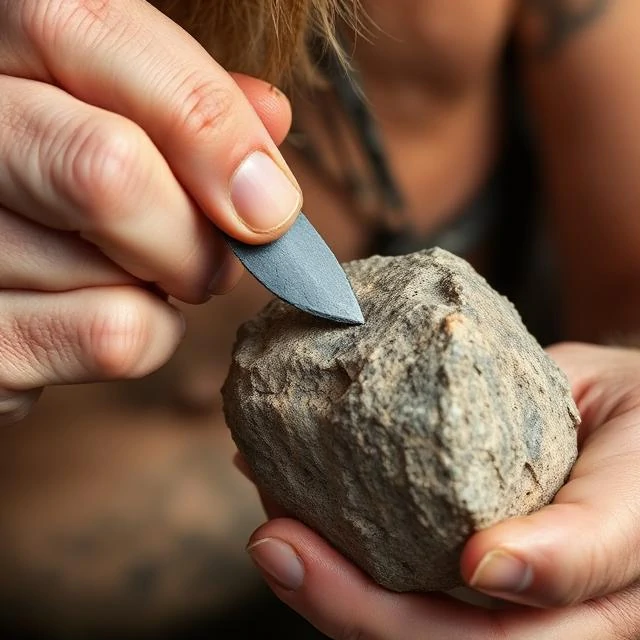
Mousterian tools belong to a stone industry associated with Neanderthals. The name comes from Le Moustier, a rock shelter in southwestern France where the tools were first identified. The industry dates roughly from 160,000 to 40,000 years ago and spread across Europe, the Near East, and North Africa. Its hallmark is the prepared-core technique, also called Levallois. The knapper shapes a core in advance so that a single well-controlled blow removes a flake of predetermined size and shape.
Mousterian toolkits include scrapers, points, and denticulates. Many were used for working hides, cutting meat, and shaping wood. Microscopic analysis of wear patterns shows that some tools served multiple purposes and were resharpened repeatedly. Neanderthals also made tools from bone and antler, though less often than later modern humans. The Mousterian is not one uniform tradition. Regional variants differ in tool proportions, suggesting local adaptations and perhaps cultural preferences.
Key points
- Prepared-core (Levallois) technology.
- Scrapers and points dominate the toolkit.
- Wear analysis reveals use on hides and wood.
- Regional variants reflect local conditions.
These tools were made by people who buried their dead, used fire, and hunted large game. They were not crude imitations of modern human technology.
Comments
No comments yet. Be the first to share a thought.
Leave a comment