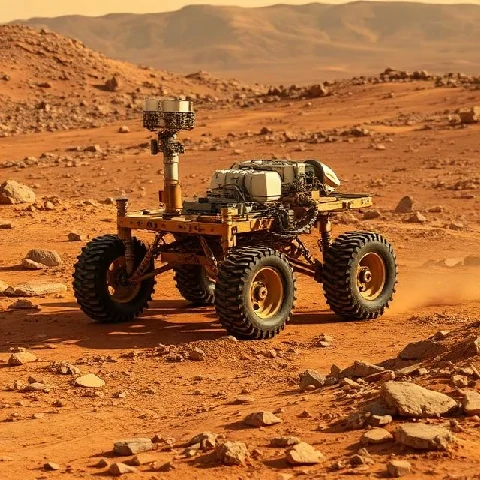
A lander stays put. A rover moves. These wheeled robots drive across the surface of another world, carrying instruments, cameras, and sometimes drills. They let scientists examine multiple sites instead of one.
Driving on Mars is slow. Signals take between three and twenty-two minutes to reach Earth, so operators cannot steer in real time. Rovers receive commands, then execute them autonomously, using onboard software to avoid hazards.
Notable rovers
- Sojourner, the first Mars rover, 1997
- Spirit and Opportunity, launched in 2003
- Curiosity, still operating in Gale Crater
- Perseverance, collecting samples for future return
Power comes from solar panels or radioisotope thermoelectric generators. Dust storms on Mars can coat solar panels and cut power, which is why nuclear sources are preferred for long missions. Each rover is built to survive years beyond its designed lifespan.
Comments
No comments yet. Be the first to share a thought.
Leave a comment