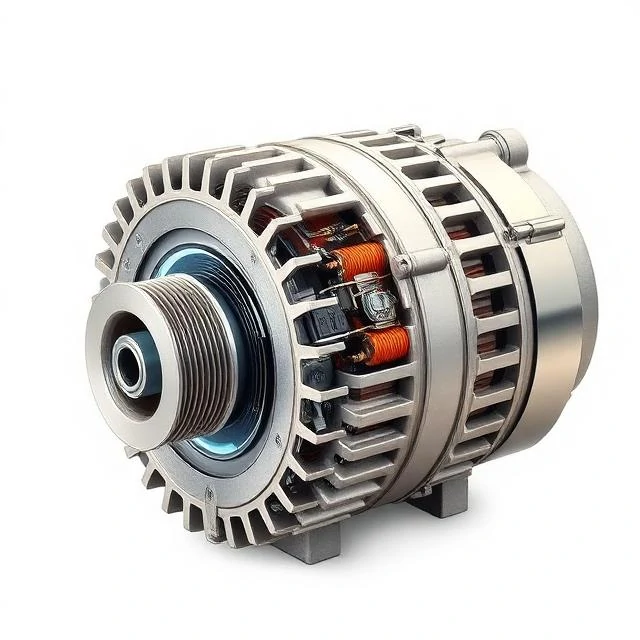
Once the engine is running, the battery stops doing the heavy lifting. The alternator takes over. It converts the mechanical energy of the spinning engine into electrical energy, charging the battery and powering the lights, ignition, infotainment, and every other electrical load in the car.
The principle is electromagnetic induction. A rotor spins inside a stator, and the moving magnetic field induces an alternating current in the stator windings. A rectifier built from diodes converts that AC into DC, which the car's electrical system uses. A voltage regulator keeps the output steady, usually around 13.5 to 14.5 volts, regardless of engine speed.
Alternators are belt-driven. A serpentine belt connects the alternator pulley to the crankshaft pulley. If the belt slips or snaps, the alternator stops charging, and the car runs on battery power alone. That lasts until the battery dies, which is usually 30 to 60 minutes. Warning signs include dimming lights, a whining noise, and a battery warning light on the dashboard.
Modern cars with start-stop systems and regenerative braking use more sophisticated alternators, sometimes called motor-generator units, that can also assist the engine. The basic job has not changed: keep the battery charged and the electronics alive.
Comments
No comments yet. Be the first to share a thought.
Leave a comment