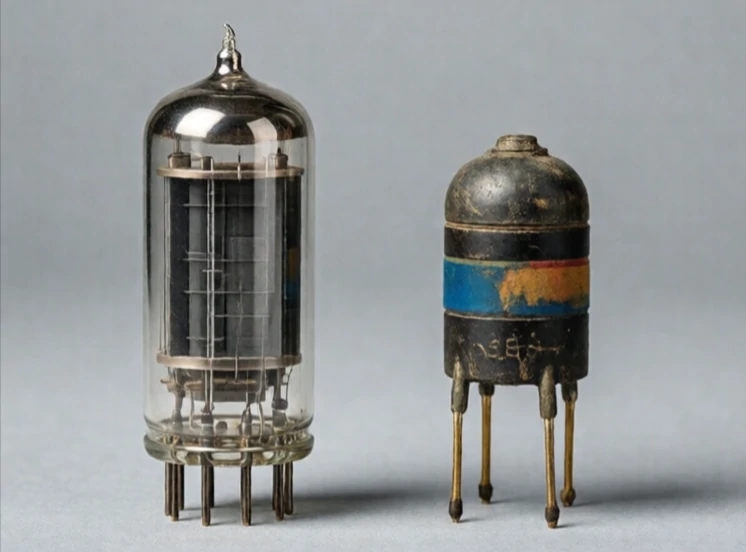
The transistor is the fundamental building block of modern electronics. It is a semiconductor device that amplifies or switches signals. A small voltage or current at one terminal controls a larger current between two others. That simple action makes logic possible. Billions of transistors fit on a single chip.
Before transistors, computers used vacuum tubes. They were huge, hot, and unreliable. The transistor was invented at Bell Labs in 1947 by John Bardeen, Walter Brattain, and William Shockley. It won them the Nobel Prize. It replaced tubes and made electronics small, cheap, and reliable.
Types of transistors
- BJT: bipolar junction, current-controlled
- MOSFET: voltage-controlled, dominant in digital circuits
- FinFET: 3D structure for better control
- GAAFET: gate-all-around, next generation
- Power transistors: handle high currents
Moore's Law described the shrinking of transistors. They went from centimeters to nanometers. Now they are approaching atomic limits. New materials and 3D architectures keep progress going. The transistor is the atom of the digital age.
Comments
No comments yet. Be the first to share a thought.
Leave a comment