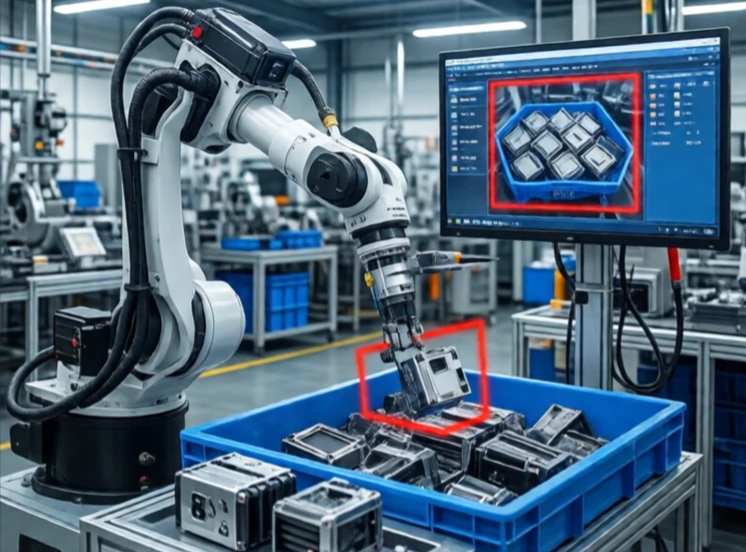
Machine vision lets machines inspect and analyze images. A camera captures a scene. Software extracts information: is the part defective? Is the label aligned? Is the weld complete? The machine makes a decision and triggers an action, usually accept or reject.
Factory automation drove the field. In the 1980s, machine vision systems used analog cameras and custom hardware. They were expensive and fragile. Today, GigE Vision and USB3 cameras feed images to industrial PCs running deep learning models. A single system can inspect hundreds of parts per minute with accuracy that exceeds human inspectors.
Machine vision applications
- Defect detection on production lines.
- Dimensional measurement and gauging.
- Barcode and OCR reading.
- Robot guidance and bin picking.
- Assembly verification and presence/absence checks.
The hardest part is lighting. A good image makes the software's job easy. A bad image makes it impossible. Machine vision engineers spend more time on lighting than on algorithms. Backlights create silhouettes. Ring lights reduce shadows. Dome lights diffuse reflections. Structured light adds depth. Once the image is clean, deep learning models can classify defects or segment objects with high accuracy. Machine vision is not about seeing like a human. It is about seeing what matters for the task, consistently, at speed, without fatigue.
Comments
No comments yet. Be the first to share a thought.
Leave a comment