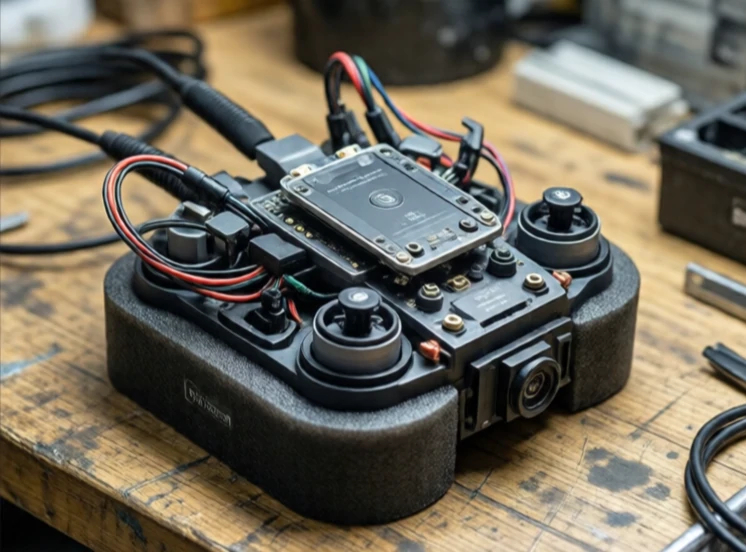
An inertial measurement unit measures how something moves. It combines accelerometers and gyroscopes to track linear acceleration and rotational rate. Add magnetometers and it becomes an AHRS, an attitude and heading reference system. The unit does not need GPS or external signals. It senses motion from the inside.
IMUs are in drones, phones, cars, and spacecraft. A drone uses one to know its tilt and rotation. A phone uses one to rotate the screen. A car uses one for stability control and dead reckoning when GPS drops out. The sensors are tiny MEMS devices etched into silicon, often smaller than a fingernail.
What an IMU measures
- Acceleration along three axes.
- Angular rate around three axes.
- Magnetic heading, if a magnetometer is included.
- Temperature, for sensor compensation.
- Barometric pressure, on some units, for altitude.
The problem is drift. Gyroscopes accumulate error over time. Accelerometers pick up vibration. A pure IMU loses its position in seconds. That is why it is almost always fused with GPS, cameras, or lidar. A Kalman filter blends the noisy IMU data with slower but more stable absolute measurements. The IMU provides the fast, high-frequency motion updates. The other sensors provide the long-term reference. Together they estimate position and orientation far better than either could alone.
Comments (3)
Leave a comment