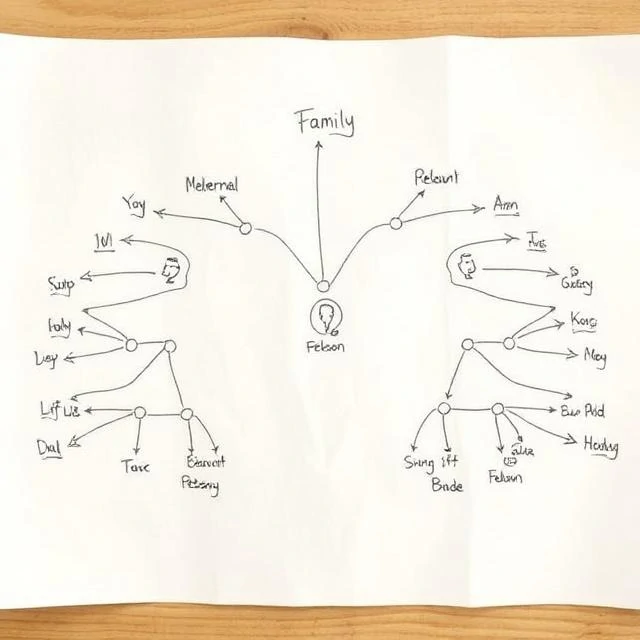
In a bilateral descent system, a person traces ancestry through both parents' lines. That sounds obvious to many people today, but it is not universal. Some societies recognize only the mother's line, others only the father's. Bilateral descent, also called cognatic descent, keeps both sides in view. You belong to your mother's relatives and your father's relatives at the same time.
This system is common in foraging societies and in many modern industrial nations. It offers flexibility. If one side of the family is distant or unhelpful, a person can lean on the other. Inheritance, residence, and support networks can flow through either line, depending on circumstance. The trade-off is that group membership is less sharply defined. There is no single clan or lineage that automatically claims you.
How it works in practice
- Kinship terms often distinguish relatives by side and generation.
- Inheritance may be divided among both parents' heirs.
- Couples may live near either spouse's family.
- Support networks can shift as needs change.
Bilateral systems show that kinship is not a fixed blueprint. It is a set of choices shaped by ecology, economy, and history.
Comments
No comments yet. Be the first to share a thought.
Leave a comment