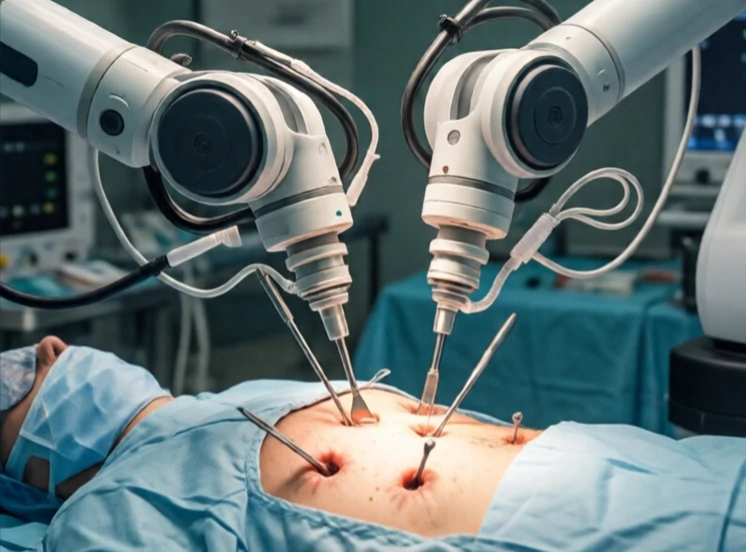
A surgical robot assists surgeons with precise operations. The surgeon controls the robot from a console. The robot holds instruments and cameras inside the patient. It translates the surgeon's hand movements into smaller, steadier motions. The robot does not operate on its own. It extends human skill.
The da Vinci Surgical System, introduced in 2000, is the most widely used surgical robot. It has four arms: one for the camera, three for instruments. The surgeon sees a magnified 3D view and controls the arms with joysticks. The system filters out hand tremor and scales motion. A 1-centimeter hand movement might become a 1-millimeter instrument movement. That precision allows smaller incisions, less blood loss, and faster recovery.
Surgical robot advantages
- Precision: scaled, tremor-free motion.
- Visualization: magnified 3D view.
- Dexterity: instruments with more degrees of freedom than the human hand.
- Ergonomics: surgeon sits comfortably.
- Teleoperation: surgeon can be remote from the patient.
Surgical robots are expensive. A da Vinci system costs over a million dollars, plus instruments and maintenance. That limits adoption to large hospitals. Smaller, cheaper systems are entering the market for specific procedures like knee replacement and spine surgery. The evidence on outcomes is mixed. Some studies show better results for complex procedures. Others show no difference compared to traditional surgery. The robot is a tool. The surgeon's skill still determines the outcome. Surgical robots are not autonomous. They are the most advanced teleoperated robots in routine clinical use.
Comments
No comments yet. Be the first to share a thought.
Leave a comment