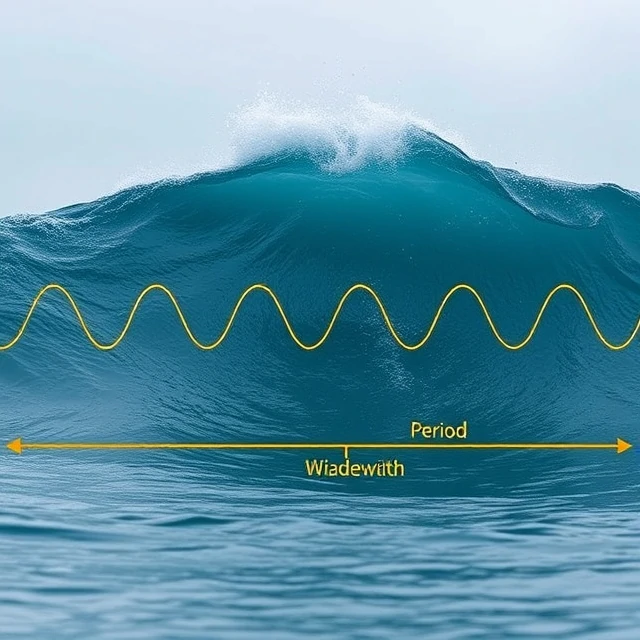
A wave is a disturbance that transfers energy through space. It does not transfer matter. A water wave moves across the ocean, but the water itself stays in place, moving up and down. A sound wave travels through air, but the air molecules do not travel with it. They vibrate back and forth. A light wave travels through space, carrying energy but no medium. Waves come in two main types. Transverse waves oscillate perpendicular to the direction of travel. Light is a transverse wave. Longitudinal waves oscillate in the same direction as travel. Sound is a longitudinal wave.
Waves have several properties. Wavelength is the distance between successive peaks. Frequency is the number of cycles per second. Amplitude is the maximum displacement from rest. Speed is how fast the wave travels. These properties are related by the equation v = fλ, where v is speed, f is frequency, and λ is wavelength. Waves can be reflected, refracted, diffracted, and interfered. They can be standing waves, like the vibrations of a guitar string, or traveling waves, like ripples on a pond. Waves are one of the most fundamental phenomena in physics. They describe everything from sound and light to quantum mechanics and gravitational waves.
Wave properties
- Wavelength. Distance between peaks.
- Frequency. Cycles per second.
- Amplitude. Maximum displacement.
- Speed. v = fλ.
- Types. Transverse, longitudinal.
A wave is not the same as a particle. A particle is a localized object. A wave is a distributed disturbance.
Comments
No comments yet. Be the first to share a thought.
Leave a comment