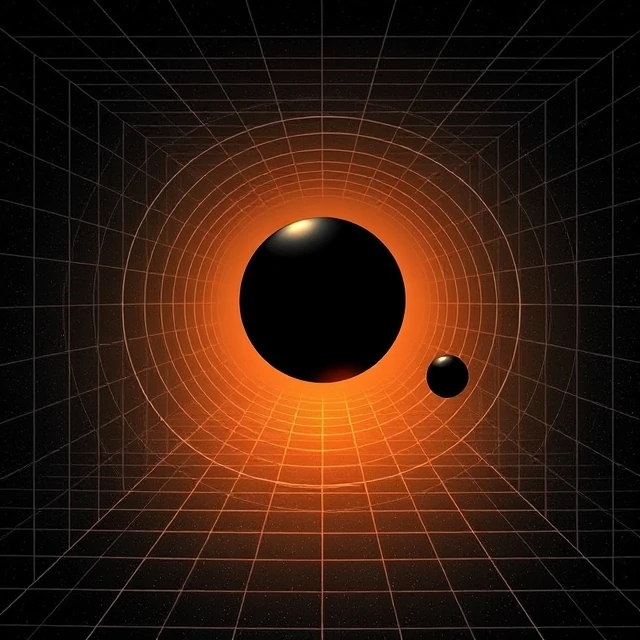
Einstein published general relativity in 1915, and it replaced Newton's law of gravity with something stranger and more accurate. Gravity is not a force that pulls objects together. It is the curvature of spacetime caused by mass and energy. A planet orbits the sun not because the sun pulls it, but because the sun's mass curves the space around it, and the planet follows the straightest possible path through that curved space. Matter tells spacetime how to curve. Spacetime tells matter how to move.
General relativity has passed every test. It explained the precession of Mercury's orbit, which Newton's theory could not. It predicted the bending of starlight by the sun, confirmed during a solar eclipse in 1919. It predicted gravitational waves, ripples in spacetime produced by accelerating masses, which were detected directly in 2015. It predicts black holes, regions where spacetime curvature becomes infinite. It also predicts the expansion of the universe, which Edwin Hubble confirmed in 1929. The theory is not complete. It does not incorporate quantum mechanics, and it breaks down at singularities. But for gravity, it is the best description we have.
General relativity facts
- Published. 1915.
- Core idea. Gravity is curvature of spacetime.
- Tests. Mercury's orbit, light bending, gravitational waves.
- Predictions. Black holes, expanding universe.
- Limitation. Incompatible with quantum mechanics.
General relativity is not the same as special relativity. Special relativity deals with constant speeds. General relativity deals with acceleration and gravity.
Comments (3)
Leave a comment