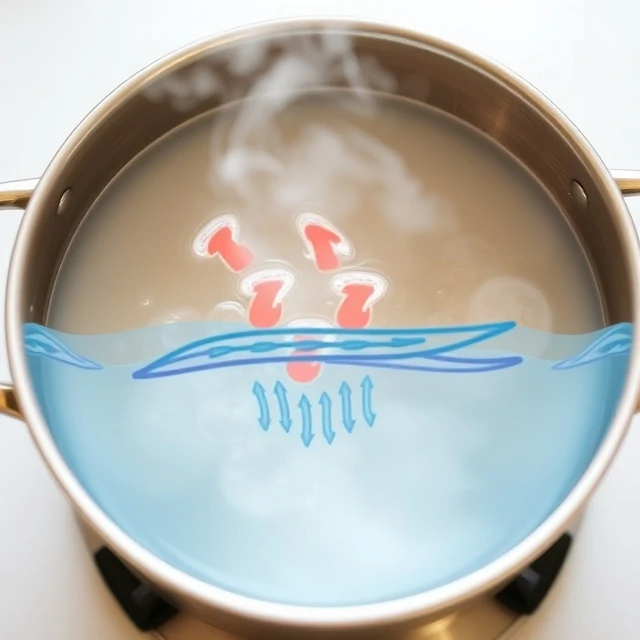
Boil a pot of water and watch the motion. The water at the bottom heats up, expands, becomes less dense, and rises. Cooler water at the top sinks to take its place. That circulation is convection, the transfer of heat through the movement of a fluid. It happens in liquids and gases, where particles are free to move. It does not happen in solids, where particles are locked in place.
Convection drives many natural phenomena. It creates wind, as warm air rises over land and cool air rushes in from the sea. It drives ocean currents, as warm water rises near the equator and cool water sinks near the poles. It powers weather systems, as warm, moist air rises and forms clouds. In the Earth's mantle, convection currents move tectonic plates over millions of years. In the sun, convection cells carry energy from the interior to the surface. Convection is often paired with conduction and radiation in discussions of heat transfer, but it is the only one that requires a moving fluid.
Convection examples
- Boiling water. Hot water rises, cool water sinks.
- Sea breeze. Warm air over land rises, cool air from the sea moves in.
- Ocean currents. Warm water rises, cool water sinks, driving circulation.
- Mantle convection. Slow currents move tectonic plates.
Convection is not the same as conduction. Conduction transfers heat through contact. Convection transfers heat through the movement of a fluid.
Comments
No comments yet. Be the first to share a thought.
Leave a comment