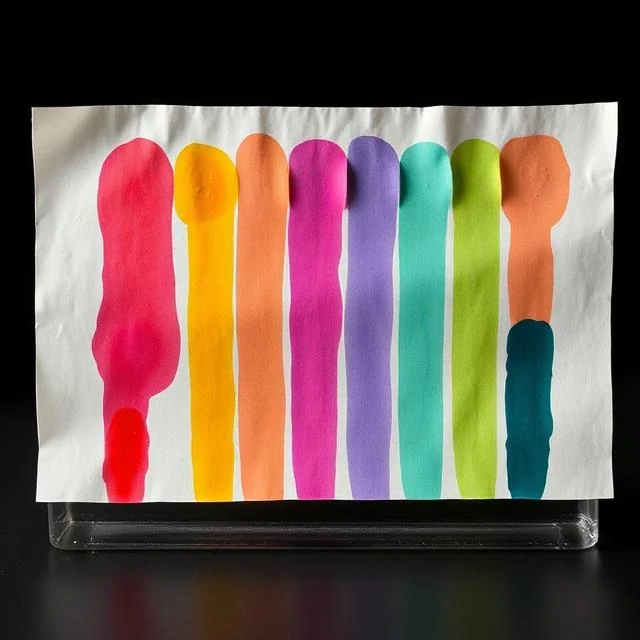
Chromatography separates mixtures. It relies on differences in how components distribute between a stationary phase and a mobile phase. The stationary phase is a solid or a liquid coated on a solid. The mobile phase is a liquid or gas that carries the mixture through the stationary phase. Components that interact more strongly with the stationary phase move slowly. Components that interact more with the mobile phase move quickly. The result is separation.
The technique comes in many forms. Paper chromatography uses paper as the stationary phase. Thin-layer chromatography uses a thin layer of silica or alumina on a plate. Gas chromatography uses a gas as the mobile phase and a liquid or solid as the stationary phase. Liquid chromatography uses a liquid mobile phase and a solid stationary phase. High-performance liquid chromatography uses high pressure and small particles for better resolution. Each form has its applications.
Chromatography is used in chemistry, biology, medicine, and industry. It purifies drugs, separates proteins, analyzes pollutants, tests athletes for doping, and identifies substances in forensic samples. It is one of the most versatile separation techniques available.
The principle was developed by Mikhail Tsvet in 1901, when he separated plant pigments on a column of calcium carbonate. The pigments separated into colored bands, giving the technique its name: chroma means color, graphein means to write.
Comments
No comments yet. Be the first to share a thought.
Leave a comment