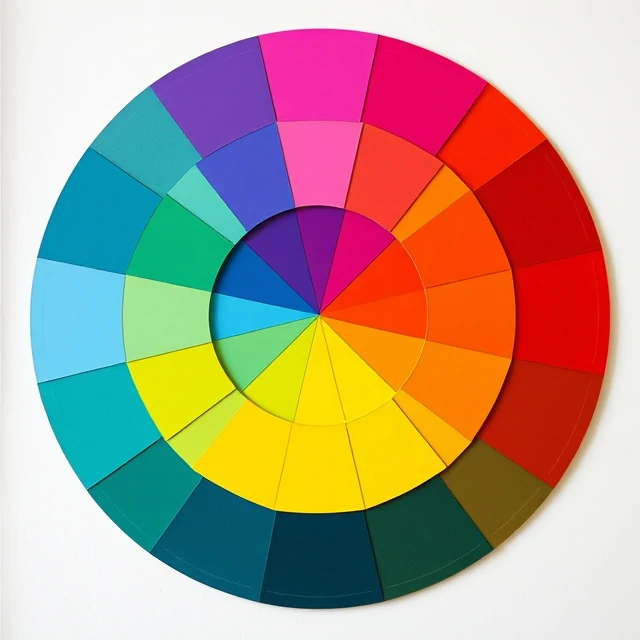
Mix two primary colors and you get a secondary color. In traditional art, where the primaries are red, yellow, and blue, the secondaries are orange, green, and purple. In additive light, where the primaries are red, green, and blue, the secondaries are cyan, magenta, and yellow. In printing, cyan, magenta, and yellow are themselves the primaries, so the secondaries are red, green, and blue. The labels shift with the system.
Secondary colors usually play a supporting role in a palette. They complement the primaries and fill out the range of available hues. A designer might use a primary color for the main brand element and a secondary for highlights or backgrounds. On the color wheel, secondaries sit between the primaries that created them, which makes them useful for building harmonious schemes.
Secondary colors by system
- RYB: orange, green, purple.
- RGB: cyan, magenta, yellow.
- CMYK: red, green, blue.
Knowing which system you are working in prevents confusion. A green mixed from blue and yellow paint is not the same green as one made from cyan and yellow ink.
Comments
No comments yet. Be the first to share a thought.
Leave a comment