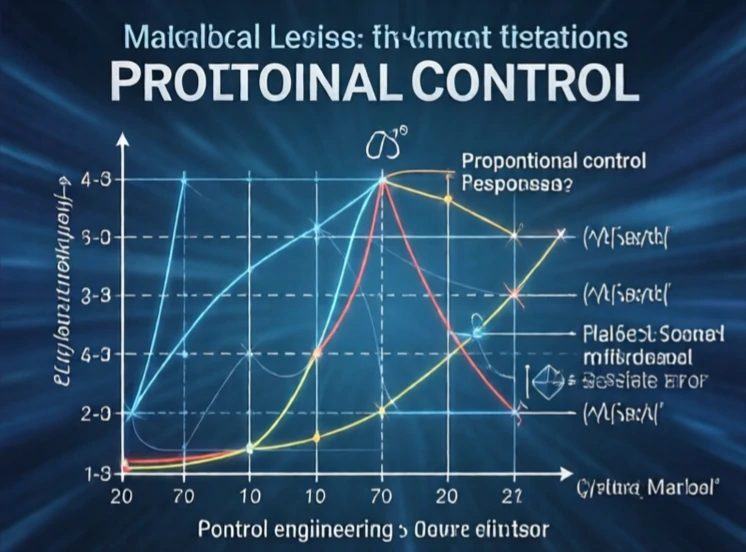
Proportional control produces an output proportional to the error. If the error doubles, the output doubles. If the error is small, the output is small. The controller pushes harder when it is far from the target and eases off as it gets closer. It is the simplest and most intuitive control action.
The proportional gain, Kp, determines how aggressively the controller responds. High gain means fast response but risk of oscillation. Low gain means stable but sluggish response. The controller output is Kp times the error. That is it. The math is trivial. The tuning is not.
Proportional control behavior
- Fast response to large errors.
- Steady-state error under constant load.
- Oscillation if gain is too high.
- Sluggish response if gain is too low.
- Often combined with integral and derivative terms.
The steady-state error is the main weakness. If the system needs a constant output to hold position against gravity or friction, the proportional term must have a nonzero error to produce that output. That means the system settles below the setpoint. Adding integral action eliminates the error. Adding derivative action reduces oscillation. Most real controllers use all three terms. But proportional control alone is enough for some applications. A simple line-following robot can use proportional control to steer. The further it drifts from the line, the harder it turns back. It works because the robot is always moving and the error never settles. Proportional control is the foundation. Everything else builds on it.
Comments
No comments yet. Be the first to share a thought.
Leave a comment