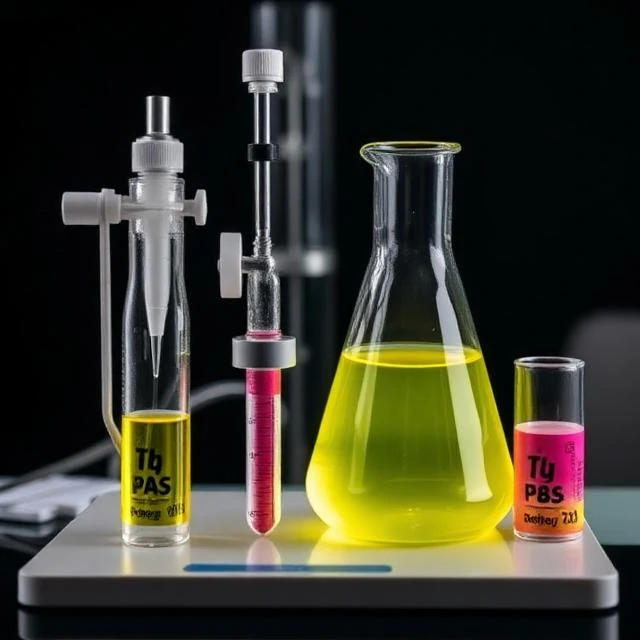
You have an acid of unknown concentration. You want to know how much is there. You add a base of known concentration until the acid is exactly neutralized. That is titration, a method to determine concentration by adding a reagent of known strength. The point of exact neutralization is the equivalence point. An indicator changes color to signal the endpoint. The volume of reagent used tells you the concentration of the unknown.
The setup is simple. A burette holds the titrant, the solution of known concentration. A flask holds the analyte, the solution of unknown concentration. The titrant is added slowly, with swirling, until the indicator changes color. The volume added is recorded. The calculation uses the stoichiometry of the reaction. For an acid-base titration, moles of acid equal moles of base at the equivalence point, adjusted for the coefficients in the balanced equation.
Titrations come in several types. Acid-base titrations determine the concentration of acids or bases. Redox titrations use oxidizing or reducing agents. Complexometric titrations use a reagent that forms a complex with the analyte, often for metal ions. Precipitation titrations form an insoluble solid. Each type has its own indicators and calculations.
Titration is used in quality control, environmental testing, pharmaceutical analysis, and research. It is precise, inexpensive, and requires only basic equipment. It is one of the most common analytical techniques in chemistry.
Comments
No comments yet. Be the first to share a thought.
Leave a comment