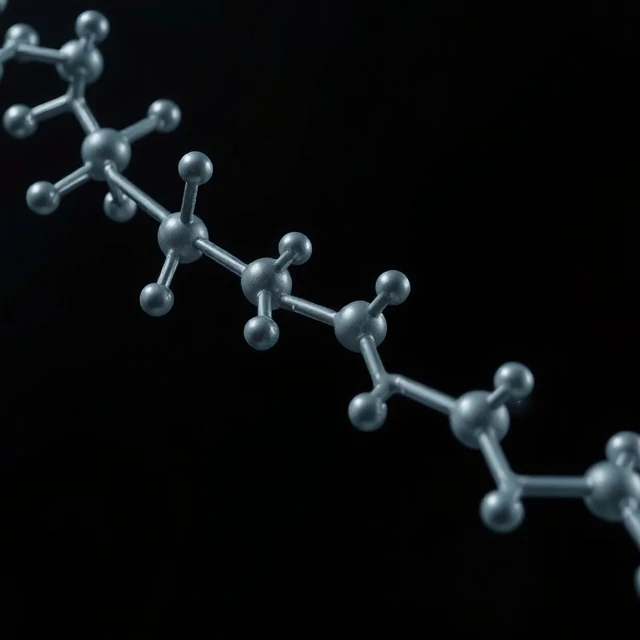
Plastic bottles, nylon rope, DNA, and cellulose. These are polymers, large molecules made of repeating structural units called monomers. The word comes from the Greek polys meaning many and meros meaning part. Polymers can be natural, like proteins and rubber, or synthetic, like polyethylene and polystyrene. They are everywhere in modern life.
Polymers form through polymerization. Addition polymerization links monomers with double bonds, like ethene, without releasing any byproducts. Condensation polymerization links monomers with functional groups, like amino acids or diacids and diols, releasing a small molecule like water. The degree of polymerization determines the chain length and the properties. Longer chains make stronger, more viscous materials.
Polymer properties depend on the monomer, the chain length, the branching, and the intermolecular forces. Polyethylene is flexible and tough. Polypropylene is stiffer. Polystyrene is rigid and transparent. Nylon is strong and elastic. Teflon is chemically inert and nonstick. By copolymerizing different monomers, chemists can create materials with tailored properties. Block copolymers, for example, can self-assemble into nanostructures.
Polymers are used in packaging, textiles, construction, medicine, and electronics. They are lightweight, durable, and cheap. They are also a source of pollution, because many do not biodegrade. Recycling and biodegradable polymers are growing fields. The polymer is a versatile material, and its story is still being written.
Comments
No comments yet. Be the first to share a thought.
Leave a comment