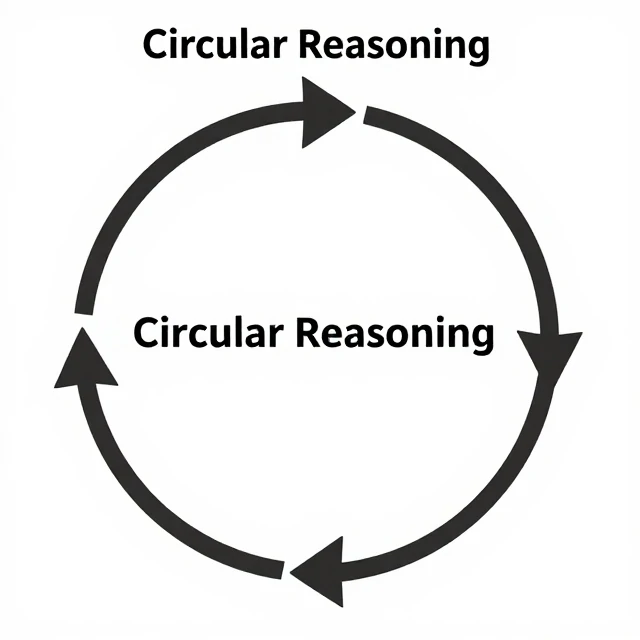
Circular reasoning is a fallacy where the conclusion is assumed in the premise. The argument goes in a circle. It supports itself. It provides no independent evidence. The conclusion is used to prove the premise, and the premise is used to prove the conclusion. Nothing is proven.
The classic example: I am trustworthy because I always tell the truth. The premise I always tell the truth assumes the conclusion I am trustworthy. The argument is circular. Another example: This statement is true because it is not false. The premise assumes the conclusion. The argument is empty.
Circular reasoning examples
- Paranormal events are real because many people have experienced them.
- The Bible is true because it is the word of God.
- He is a good leader because he leads well.
- This policy is right because it is correct.
- I know it is true because I believe it.
Circular reasoning is a closed loop. It cannot be refuted because it does not engage with external evidence. It is self-contained. The argument feels persuasive to the person making it. They believe the premise. They believe the conclusion. They do not see the circle. The remedy is to ask: what evidence supports the premise independently of the conclusion? If the premise is just the conclusion reworded, the argument is circular. Circular reasoning is common in politics, religion, and personal relationships. It is a way of avoiding evidence. It protects beliefs from challenge. It is a closed system. It cannot be falsified. That is its weakness. An argument that cannot be falsified cannot be proven. It just is. Circular reasoning is a circle. It goes nowhere.
Comments
No comments yet. Be the first to share a thought.
Leave a comment