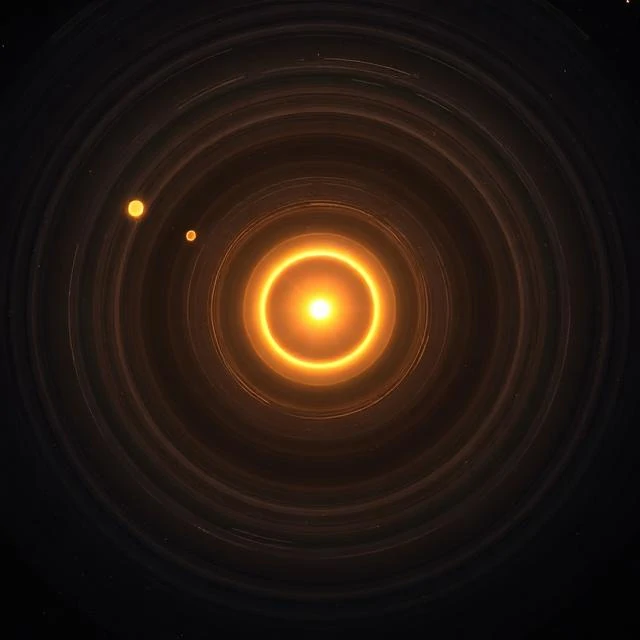
The nebular hypothesis explains how the solar system formed from a rotating cloud of gas and dust. It was proposed in the 18th century by Immanuel Kant and Pierre-Simon Laplace, and it has been refined ever since. The basic idea has survived because it explains so much: why the planets orbit the Sun in the same direction, why their orbits lie roughly in the same plane, and why the Sun and planets have similar compositions.
The story goes like this. A giant molecular cloud collapsed under its own gravity, possibly triggered by a nearby supernova. As it collapsed, it spun faster and flattened into a disk. The center grew dense and hot, eventually igniting nuclear fusion and becoming the Sun. In the disk, dust grains stuck together, forming pebbles, then rocks, then planetesimals. Some planetesimals grew large enough to become planets. Others remained as asteroids and comets.
The hypothesis has been tested by observations of other stars. Astronomers have found protoplanetary disks around young stars, some with gaps where planets are forming. The Kepler and ALMA observatories have provided direct evidence. The model is not perfect. It struggles to explain how giant planets formed so quickly, and how the solar system's architecture evolved. But it remains the foundation of planetary science.
Comments
No comments yet. Be the first to share a thought.
Leave a comment