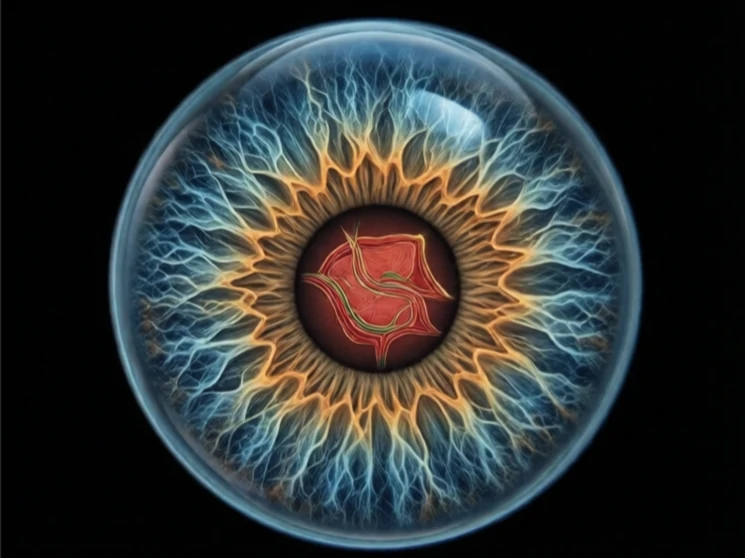
The retina is the light-sensitive inner surface at the back of the eye. It contains the photoreceptors and the initial neural circuitry that convert light into electrical signals.
Rods and cones form the outermost layer of photoreceptors. Their signals are processed by bipolar cells, horizontal cells, and amacrine cells before reaching the ganglion cells, whose axons form the optic nerve. The retina is not a passive sensor; it performs substantial computation, including center-surround antagonism and the beginnings of motion and color processing. The fovea, densely packed with cones, provides high-acuity central vision; the periphery, richer in rods, is more sensitive to dim light and motion.
Light must pass through the layers of neural cells before reaching the photoreceptors, an arrangement that appears inverted yet works efficiently. Diseases of the retina—macular degeneration, retinitis pigmentosa, diabetic retinopathy—are leading causes of vision loss. The retina is the only part of the central nervous system that can be observed directly through the pupil.
Every visual experience begins with the pattern of light falling on the retina.
Comments
No comments yet. Be the first to share a thought.
Leave a comment