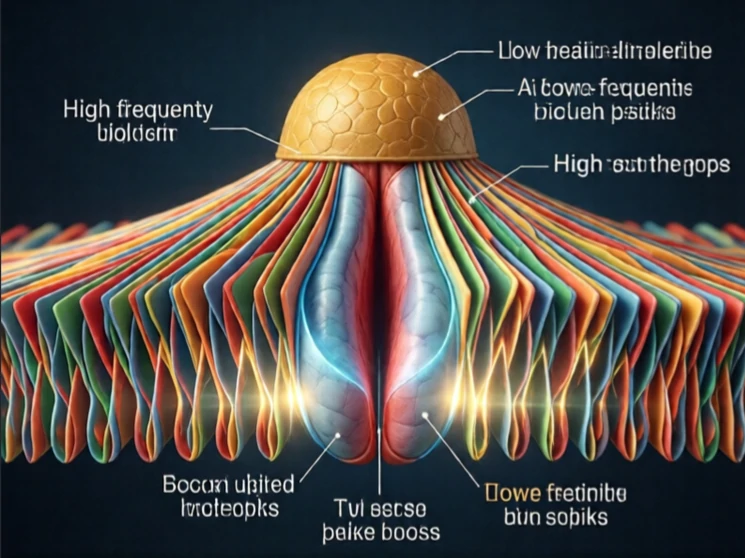
Place theory proposes that different frequencies of sound stimulate different places along the basilar membrane of the cochlea, and that the brain determines pitch from the location of the peak stimulation.
High-frequency sounds produce maximal vibration near the base of the cochlea, close to the oval window. Low-frequency sounds travel farther and peak near the apex. Hair cells at each location send signals that the auditory system interprets as corresponding pitches. The theory accounts well for the perception of high frequencies and is supported by the orderly tonotopic organization found throughout the auditory pathway.
For low frequencies, place coding becomes less precise, and temporal coding of the frequency itself becomes more important. Modern accounts therefore combine place and frequency theories, assigning each a dominant role in different parts of the audible range. Place theory remains the primary explanation for how the cochlea begins the analysis of pitch.
Where the basilar membrane vibrates most strongly is, according to place theory, what determines the pitch that is heard.
Comments
No comments yet. Be the first to share a thought.
Leave a comment