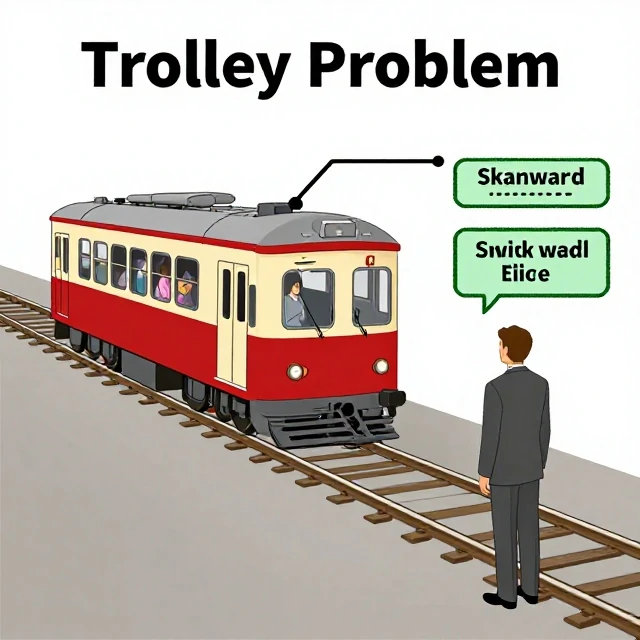
The trolley problem is an ethical thought experiment about sacrificing one to save many. A runaway trolley is heading down a track. Five people are tied to the track. You are standing next to a switch. If you pull the switch, the trolley diverts to another track. One person is tied to that track. Do you pull the switch? Most people say yes. Kill one to save five.
The problem was introduced by Philippa Foot in 1967. It has many variations. The footbridge variant asks whether you would push a fat man off a bridge to stop the trolley. Most people say no. The two scenarios are structurally similar. One death to save five. But the intuitions differ. Pulling a switch is impersonal. Pushing a man is personal. The trolley problem explores the difference.
Trolley problem variations
- Standard: pull the switch, divert the trolley.
- Footbridge: push a man to stop the trolley.
- Loop: the diverted trolley loops back to the five.
- Fat man: use a fat man's body to block the trolley.
- Transplant: kill one healthy patient to save five sick ones.
The trolley problem is used in ethics, psychology, and neuroscience. It tests moral intuitions. It reveals whether people are consequentialist or deontological. Consequentialists focus on outcomes. They pull the switch. Deontologists focus on rules. They do not push the man. The problem has no single answer. It is a tool for exploring moral reasoning. It is also a cultural phenomenon. It appears in books, movies, and video games. It is a simple scenario with endless variations. It asks: what is the right thing to do? The answer depends on your ethics. The trolley problem does not tell you what to do. It shows you what you believe.
Comments
No comments yet. Be the first to share a thought.
Leave a comment