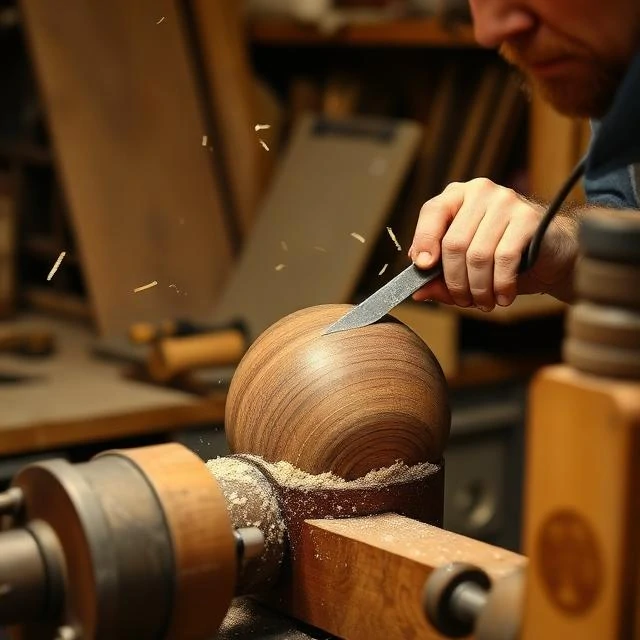
Woodturning shapes wood on a lathe. The wood spins, and the turner holds a chisel against it to cut away material. The result is round, symmetrical, and often smooth right off the tool. Bowls, cups, chair legs, tool handles, and decorative spindles are all turned. The lathe can be a simple pole lathe powered by a foot pedal or a modern electric lathe with variable speed and a heavy cast-iron bed.
Turning green wood is different from turning dry wood. Green wood is wet, cuts easily, and moves as it dries. A green-turned bowl often warps into an oval shape, which some turners find beautiful and others find frustrating. Dry wood is stable but harder and dustier. Spindle turning works between centers, with the wood held at both ends. Bowl turning uses a faceplate or chuck and works on the end grain. The two disciplines use different tools and different techniques.
Basic turning tools
- Gouge — the workhorse for roughing and shaping
- Skew chisel — for smooth planing cuts on spindles
- Parting tool — for cutting grooves and separating the finished piece
- Scraper — for smoothing and refining curves
Sharp tools and light cuts. Forcing a gouge into spinning wood catches the grain and can throw the tool or the work. Stand to the side of the lathe, not directly in line with the spinning wood.
Comments
No comments yet. Be the first to share a thought.
Leave a comment