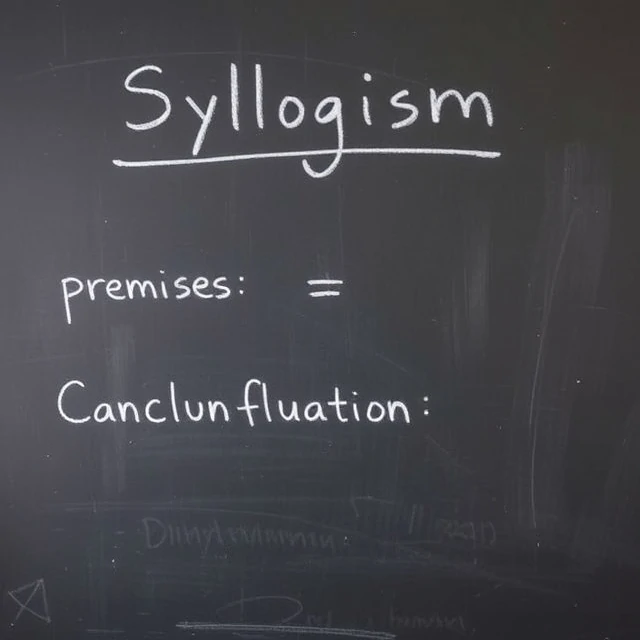
Start with premises that guarantee a conclusion and you are reasoning deductively. All men are mortal. Socrates is a man. Therefore, Socrates is mortal. If the premises are true and the form is valid, the conclusion must be true. There is no room for probability. Deduction is the backbone of logic, mathematics, and formal proof.
Aristotle was the first to systematize deduction, using the syllogism as his basic tool. A syllogism has two premises and a conclusion, arranged so that the conclusion follows necessarily. Medieval logicians refined the system, and modern logicians like Frege and Russell developed symbolic logic, which represents deductive forms with symbols and rules. Deduction is truth-preserving: it cannot take you from true premises to a false conclusion. But it cannot generate new content beyond what the premises already contain. That is why deduction is powerful for proof and limited for discovery.
Key concepts
- Validity. The conclusion follows necessarily from the premises.
- Soundness. Valid form plus true premises.
- Syllogism. Two premises and a conclusion.
- Counterexample. A case showing an invalid form.
Deduction appears in everyday reasoning, legal argument, computer programming, and philosophical proof. When someone says "it follows logically," they usually mean deductively.
Comments
No comments yet. Be the first to share a thought.
Leave a comment