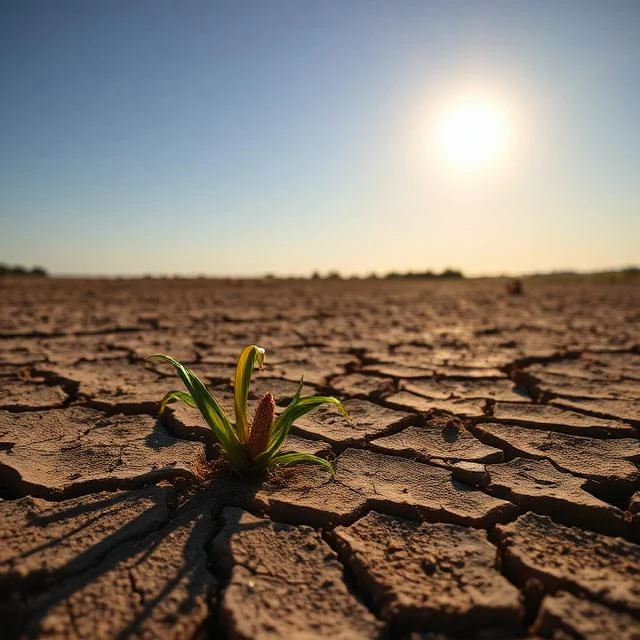
An extended period of abnormally low rainfall affecting crops.
☀️
Drought is an extended period of abnormally low precipitation that causes water shortage and affects crops, livestock, and human communities. Droughts are classified as meteorological (rainfall deficit), agricultural (soil moisture deficit affecting crops), hydrological (low river and reservoir levels), and socioeconomic (water demand exceeding supply). They develop slowly and can last months or years, with impacts compounded by heat, wind, and high evaporation. Historic droughts such as the American Dust Bowl of the 1930s, the Sahel droughts of the 1970s and 1980s, and the Australian Millennium Drought caused widespread crop failure, famine, and migration. Climate change is expected to increase drought frequency and severity in many regions, including the Mediterranean, southwestern United States, and southern Africa. Adaptation strategies include drought-tolerant crop varieties, deficit irrigation, water harvesting, mulching, and diversification of income. Drought monitoring uses satellite data, soil moisture sensors, and indices such as the Palmer Drought Severity Index to guide response and relief.
Comments (2)
Sandra M.
Droughts are becoming more frequent and severe in many regions. Climate change is making a bad situation worse.
Ken W.
The article is clear but could mention that drought isn't just about rainfall. Temperature and soil moisture matter too.
Comments (2)
Leave a comment