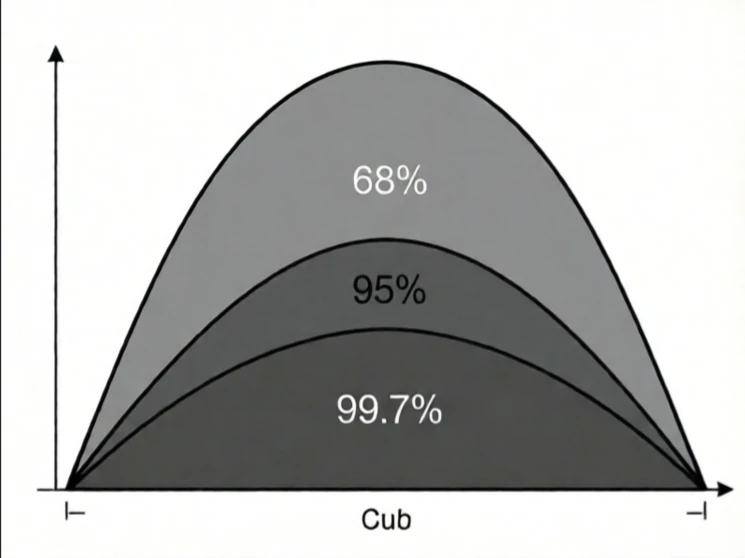
The normal curve, also called the normal distribution or bell curve, is a symmetrical, bell-shaped distribution that describes the probability of many physical and psychological attributes. It is defined by its mean and standard deviation.
In a normal distribution, the mean, median, and mode coincide at the centre. About 68% of values fall within one standard deviation of the mean, about 95% within two, and about 99.7% within three—the empirical rule. Many psychological measures, such as IQ and height, are approximately normally distributed. Standardised tests are often designed so that scores follow a normal curve, allowing percentile interpretation.
Key properties
- Symmetrical and bell-shaped
- Mean = median = mode at centre
- 68–95–99.7 rule
- Defined by mean and standard deviation
Comments
No comments yet. Be the first to share a thought.
Leave a comment