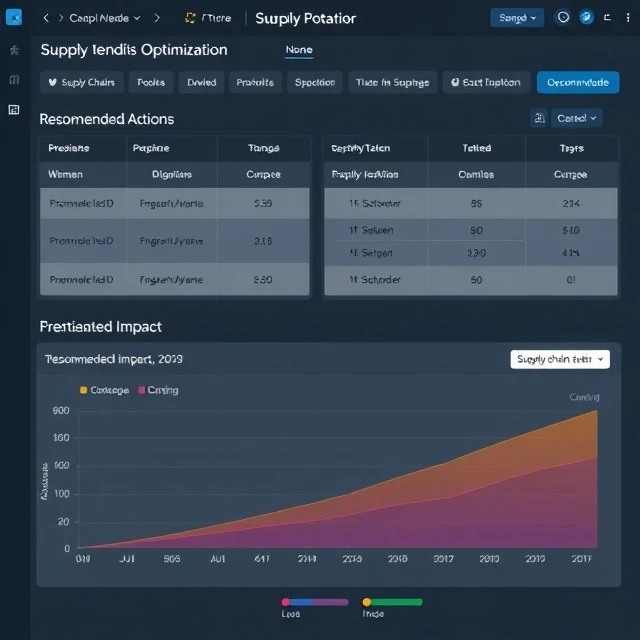
Prescriptive analytics recommends actions. It answers the question: what should we do? Predictive analytics forecasts what will happen. Prescriptive analytics goes further, suggesting what to do about it. A supply chain model predicts a shortage of a key component. A prescriptive model recommends rerouting orders to an alternate supplier, adjusting production schedules, and notifying customers. The recommendation accounts for constraints: budget, capacity, contracts, and time.
The techniques include optimization, simulation, and decision analysis. Optimization finds the best solution given constraints. Linear programming, integer programming, and genetic algorithms all fall into this category. Simulation models different scenarios and compares outcomes. Monte Carlo simulation runs thousands of random trials to estimate the range of possible results. Decision analysis structures complex choices with multiple criteria and uncertain outcomes. Prescriptive analytics is the most advanced and least adopted level. It requires clean data, sophisticated models, and organizational willingness to act on algorithmic recommendations. Many organizations stop at predictive because acting on predictions requires changing processes and trusting the model. Prescriptive analytics also raises questions about accountability. If the model recommends an action and the action fails, who is responsible? The data scientist, the manager, or the algorithm? Those questions slow adoption. The technology is ready. The governance is not.
Prescriptive techniques
- Optimization — find the best solution under constraints
- Simulation — model scenarios and compare outcomes
- Decision analysis — structure complex choices
- Recommendation engines — suggest actions or items
- Reinforcement learning — learn optimal actions over time
Prescriptive analytics does not just predict. It prescribes. The prescription is only useful if someone fills it.
Comments
No comments yet. Be the first to share a thought.
Leave a comment