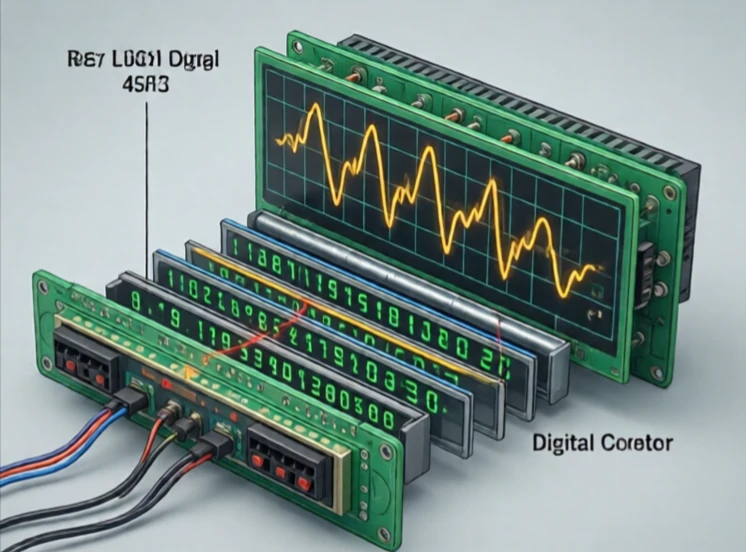
Your voice is analog. Your phone transmits digital. Between them sits an analog-to-digital converter. It samples a continuous signal at regular intervals and rounds each sample to the nearest digital value. The result is a stream of numbers that a computer can process.
The process has two steps: sampling and quantization. Sampling captures the signal at discrete moments. The Nyquist theorem says you must sample at least twice the highest frequency to avoid distortion. Quantization assigns each sample a binary number. More bits mean finer resolution and less error.
Key specs
- Sample rate: samples per second, in Hz
- Resolution: bits per sample, like 8, 16, 24
- Accuracy: how closely it matches the original
- Speed: how fast it can convert
ADCs are everywhere. They are in phones, cameras, medical devices, and industrial sensors. A digital camera uses an ADC to convert light levels into pixels. A voice assistant uses one to convert your speech into data. The analog world meets the digital world at the ADC.
Comments
No comments yet. Be the first to share a thought.
Leave a comment