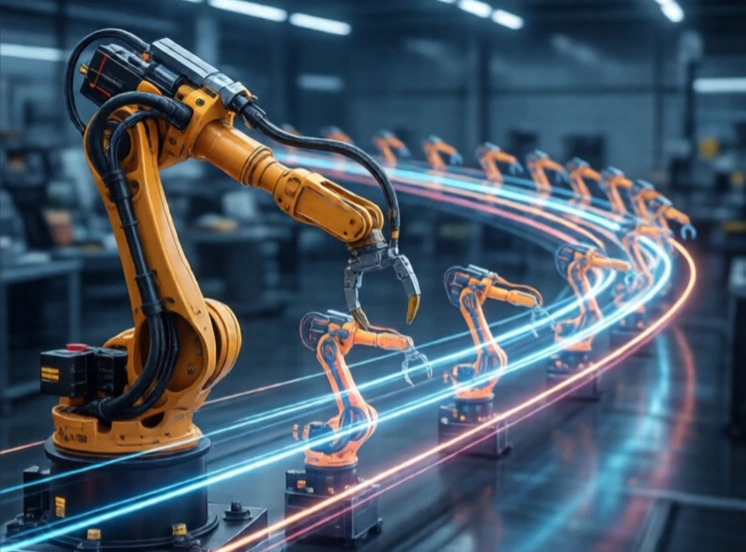
A trajectory is the path a robot follows through space and time. It is more than a path. A path is just geometry. A trajectory includes velocity, acceleration, and timing. It specifies where the robot is at every moment, not just the route it takes.
Trajectory generation is a core problem in robotics. The controller needs a smooth reference to follow. A step change in position would require infinite acceleration. Real motors cannot do that. So the trajectory generator creates a smooth curve, often a polynomial or a spline, that respects velocity and acceleration limits. The robot follows the trajectory as closely as it can.
Trajectory characteristics
- Position, velocity, and acceleration profiles.
- Jerk: the rate of change of acceleration, minimized for smoothness.
- Time-optimal: fastest possible within limits.
- Smooth: minimizes wear and vibration.
- Collision-free: avoids obstacles along the way.
A good trajectory is smooth and efficient. A bad one is jerky and slow. Jerk, the derivative of acceleration, is especially important. High jerk causes vibration, wear, and noise. Trajectory generators minimize jerk by using S-curve profiles instead of trapezoidal profiles. The S-curve ramps acceleration gradually, producing smoother motion. Trajectories are computed in joint space or Cartesian space. Joint space trajectories are easier to compute and avoid singularities. Cartesian space trajectories are more intuitive but can require complex inverse kinematics. The choice depends on the task. A welding robot follows a Cartesian trajectory along a seam. A pick-and-place robot might use a joint space trajectory for speed. The trajectory is the robot's plan in motion.
Comments (2)
Leave a comment